BetVoyager online casino

Argh, another "such" reply from Chris. Chris, you know, it would have been fine just to write: "After Jufo's explanation I understand Randomness control better now. Yes, it looks like it works as advertised. I stand corrected." ;)

But you took the longer route again. Nothing wrong with that, but some of the topics in your post relating to Galewind would probably be better served in the "RTP Critiques" thread, which might need to be resurrected from the grave.

Sorry. The subject of my post jumped several steps ahead in the conversation.

To be accurate, I never expected that my silly "Tin Foil Hat" observation, extracted from the "Return to Player - Critiques Requested." thread, would ever be taken seriously. It was so obviously flawed that I expected it to be shot full of holes with little thought or effort.

I also never questioned the impenetrability of the SHA-256 algorithm. That would be the equivalent of my questioning 256-bit encryption in general.

So, in my mind, all of these were "given as true". I thus moved ahead in the "conversation".

Where I jumped:

Wow, great idea. But it follows on the heels of many other "great ideas". And these other "great ideas" have proven insufficient.

Therefore, does this "great idea" finally satisfy the objective; does it guarantee that "the game is not rigged"?

If yes, very cool.

If no, a whole lot of wasted time, effort, and money. Not cool at all.

Yes, I framed my (admittedly lengthy) response within the context of "The Galewind World". I'll remind you: This is the only world about which I am allowed to speak, the only world about which I can speak with any accuracy

But in doing so I provided hard data, and confirmed references, within a valid and logical argument structure. There are no "vague references", no "out of context" quotes, no unverified data.

In short: no bullshit.

And yes, I agree with you - if my post was in response to the issue of the SHA-256 algorithm, or its use within BetVoyager's RC System - way over the top.

As to answering the question - "Does this RC System guarantee that the game is not rigged?" - I think that you have done an eloquent job here.

Chris
 
I could have made a couple mistakes on poker, but Punto Banco and AR - how could I misplay, thus having increased their house edge? And finaly, how could have I lost more than expected on Blackjack where I play better than basic strategy?


Aren't you exagerating, bloke? How can you possibly play better?
 
Randomness of shuffle in card games

In card games the problem is that the Randomness control isn't sufficient to guarantee that the deck or shoe is shuffled perfectly randomly.

...

The solution or "fix" would be that instead of just choosing one shift value for the shuffle, the player could choose the indexes for all the five cards he is going to draw. So when playing Video poker I could request that (after the shuffle is done by the server) I am going to pick cards #7, #14, #21, #1, #47 to form my initial hand and if I get a 4-to-a-royal I will pick card #36 as the one replacement card. This sort of control would eliminate this issue. I hope Betvoyager staff reads this post and implements this system as soon as possible.

Argh, another "such" reply from Chris.

But, now that we are talking about your system and not BetVoyager's, I don't have to be "silly", and I can get right to the point. :)


I've thought about it for a couple of days, and I've concluded that you may have created a truly viable solution here.

Stud Poker Example:

  1. The server creates a shuffled deck, keeps a master copy and a working copy, creates and sends you a checksum.
  2. You ante, and I "fan the deck" on the table, cards down.
  3. You mouse-over the fan, and click-select the cards that you want.
  4. Cards move to the Player Hand or Dealer Hand as clicked. (The card's "fan index number" follows the card on the table for later reference.)
  5. After both hands have their cards, you play through the game.
  6. When finished, I send you the master copy of the deck.
  7. You verify the checksum.
  8. You verify that the "fan index numbers" for the cards you see on your table match the ones that are in the deck.
Jufo - Yes? Have I understood you correctly?

I really think you may have hit on it. I think that this system would indeed guarantee that the game is not rigged. I've thought about it for 2 days now, and I can't see any holes in it. (See *** comment below.)

I think that congratulations to Jufo are in order here! :notworthy

Hip Hip Hooray! Hip Hip Hooray! Hip Hip Hooray!


Okay, enough of that. Let's get back to work.

I think that, for purposes of full disclosure, I should send both a string version of the deck ("ac" for Ace of Clubs, "6h" for 6 of Hearts, and like that) and an integer version of the deck (numbers 1 to 52). You could copy the integer version into Excel (integers are a whole lot easier for statistical analysis), and also do a number-to-string comparison to make sure that the deck is clean.

*** Indeed, I think that without this additional step of making sure that the deck is "clean", there is still the possibility of fraud.

However, it would be relatively easy to build up the data pile needed for a complete analysis given a several hundred round (or more) sample set. (You could even write Excel functions to do this testing by the click of a button, which would be marginally cool.)

And since I'm already sending you a pile of data, I could even include the Player's cards, the Dealer's cards, the bet amount, game result, and like that. In other words, real-time Player history, taken to an extreme level.


For Stud Poker, and a few of the other Table games, I can see my way through to building something that looks at least moderately attractive as a card game. In other words, I'd like to build a game that has some graphical appeal, rather than looking like a 1980s Bank ATM.

I can see things getting pretty messy with the 6-deck shoe of Blackjack, and even worse with the 8-deck shoe of Pontoon. For Baccarat, forget it. That would require a complete re-build.

I can envision a system for the Video Pokers that won't wind up looking like shit. Actually, what I see in my mind for these games would look pretty nice.

So, right now anyway, I can see my way to building this system into most of our current games in such a way that they still remain relatively attractive, easy to use, and like that.


BUT ... (There's always a "but", isn't there.)


There are a few functional problems here.

1. These games would have to be created as separate Flash Files. I can't see any way around that. There would have to be a Stud Poker file that shows this interface, and another Stud Poker file that doesn't. For Galewind's relatively limited resources, this kind of sucks.

2. Because of this, the only games that you can "certify as clean" are the files that show this interface. The standard files would remain suspect.

3. This might prove to be a security nightmare. Flash files are easily cracked by the User. (I don't exaggerate when I say that different people have been "hack attacking" the server code pretty much every day for over 7 years.)

4. From a "server load" perspective, this is probably the least efficient way to use resources. Galewind currently doesn't "shuffle the deck". (Why have the CPU hit of a 416-card Pontoon shuffle to process a 4-card or 5-card game?) That would no longer work here - a full shuffle would be required. And each card selection represents a client-to-server call. So the current 2-call Stud Poker game (Deal + Raise) now goes to a 12-call game (Deal, 10 cards, Raise). (I have to think about shit like this.)

5. I understand the system, and I might play a little bit (a very little bit) with these games, but 99% of my play would be in the standard game files. (Of course, I might feel entirely different if I weren't playing my own software.)

6. For those that don't understand the system (more than 95% of the users?), they wouldn't touch these with a 10-foot pole.

However, to satisfy curiosity, it would be interesting to put up a Stud Poker game that deploys this interface, and then compare the action between the 2 versions.

But, shooting from the hip here, I'd have to conclude that, although this system is "A Really Great Idea", I'm not sure that it would pay back on the time and effort needed to build it. Given that Galewind is a "Level 5 Transparency" Casino, I remain unconvinced.

BTW, given that we don't have any "Robots exclusion", "Pattern Betting exclusion", "Spirit of the Bonus exclusion", "Hacking the Game exclusion", or really anything like that in the T&Cs, does that make us a "Level 6 Transparency" Casino? :D

Chris
 
Can you guys please explain me why it is not enough just to cut every deck in card games?

It's because the Player can't be certain that they are actually cutting a "randomly shuffled" deck and not a "created" or "crafted" deck.

In card games the problem is that the Randomness control isn't sufficient to guarantee that the deck or shoe is shuffled perfectly randomly. Yes, after every round you get to see the complete shuffle in it's entirety but you still don't know how exactly it was produced. The option for the player to shift the starting position of the shuffle to any value (in other words cutting the shoe) isn't sufficient to overcome this, because suppose that the shuffling procedure was biased so that it never lets five suited high cards (10-A) to be within a span of Five or Six from each either. In video poker this means that the player could never get a pat royal flush (span 5) or a royal flush by drawing one card to a 4-to-a-royal (span 6), no matter what initial cutting point (shift) he chooses. So this is a problem that the randomness control in it's current form cannot eliminate.

The purpose here, or the point of greatest interest to me anyway, was to discuss and/or as necessary define a system which, regardless of who put on the "Tin Foil Hat", or how frequently it was used, would pass all conceivable fraud speculations.

The system that Jufo has proposed, the system that he has created, is one that I believe removes any possibility of Casino fraud from the card game.

(I don't know whether such a system has previously been proposed by another, but if not then I think that Jufo's name should go down in whatever records are kept on this kind of stuff as The Man Who Defined The System.)

The purpose for the server shuffle has now changed to making sure that the Player won't know what cards they are choosing. The fact that the Player is now choosing (blindly choosing, but choosing all the same) whatever cards they want, from anywhere within the deck, means that the Server has literally no way to predict, or control, the final hand(s).

The bottom line is that a deck can't be "crafted" in any manner to overcome this final variable. (Short of actually doing something like replacing an Ace with a Deuce, which is why I indicated that this is a required final verification of a "clean deck". However, I also agree with Jufo's earlier observation that if the Casino actually did something as easily discovered as this, then that would blow the lid on the pot sky high.)

And finally, the current BetVoyager RC checksum system is what ties it all together.

I'd also like to clarify a phrase that I used in the closing comments of my previous post: "... I remain unconvinced." My use of the word "unconvinced" is not accurate; I'm convinced of the effectiveness of the system. I'm unsure only of the "return on the investment" if we developed and deployed it, for the reasons which I have enumerated.

Chris
 
Last edited:
Thanks for posting that info! :thumbsup:
Like most other things about this casino - I see their affy program is totally unique - affiliates only make any money when the players WIN, and make nothing when they lose...
I can't honestly say that I think many other affys will take them up on those terms.

KK

But I'm assuming they're talking about their even odds games. Isn't there like a 50 % chance of winning then? Makes sense to me....i'm assuming the affiliates will want to bring their aquaintances to the site since they will both benefit from the win.
 
I've thought about it for a couple of days, and I've concluded that you may have created a truly viable solution here.

Stud Poker Example:

  1. The server creates a shuffled deck, keeps a master copy and a working copy, creates and sends you a checksum.
  2. You ante, and I "fan the deck" on the table, cards down.
  3. You mouse-over the fan, and click-select the cards that you want.
  4. Cards move to the Player Hand or Dealer Hand as clicked. (The card's "fan index number" follows the card on the table for later reference.)
  5. After both hands have their cards, you play through the game.
  6. When finished, I send you the master copy of the deck.
  7. You verify the checksum.
  8. You verify that the "fan index numbers" for the cards you see on your table match the ones that are in the deck.
Jufo - Yes? Have I understood you correctly?

I really think you may have hit on it. I think that this system would indeed guarantee that the game is not rigged. I've thought about it for 2 days now, and I can't see any holes in it. (See *** comment below.)

Yes, seems like what I meant. I'll give some screenshots below to illustrate it.

Let's choose Oasis poker at Betvoyager (very similar game to Caribbean Stud in your example above). You Chris (and anyone who is reading this) can open their own Oasis game from here (no need to register or anything) and test it themselves: Old / Expired Link

It should be noted that the demo version is identical to the real money game with all the RC functions enabled.

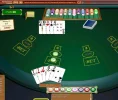
From the top menu I choose arbitary cutting point of "9" and then deal my hand (your result will obviously differ from mine). I get a pair of Sevens versus Dealer Seven and obviously raise the hand. The result is:
betvoyager1.webp

So dealer didn't qualify against my pair of 7's and I won amount equal to ante bet (here 10 euros).

Then I click the "V" symbol to see how the deck was shuffled. I get the following string:

"deck : 9d, Ah, As, 8d, 6h, 10s, Jc, Kd, Ac, Jh, Qs, 8c, 6c, 7c, 10c, 2s, 8h, 7d, 7s, 4s, 2h, 3h, 6s, 9h, 10h, 4d, Ad, 5c, Ks, 2c, Qd, 4c, 3d, 5h, 5d, 6d, 9c, Kh, 4h, 5s, Kc, 10d, Qc, 9s, 3s, Qh, Jd, 7h, 2d, 3c, 8s, Js; server code word : 027f0a60c5dd62b992420797c53781bb"

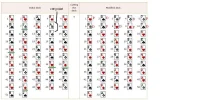
Below the result string (whose SHA-256 checksum you can always check) is the same information in graphical format:
betvoyager2.webp

Now look at the right-hand side, which shows the deck being cut after 9 cards. Every second card is dealt to the player and every second to the dealer by the standard dealing procedures so I marked to the image each card that belongs to the player ("P") and to the dealer ("D). By comparing to the previous screenshot you see that the cards match with what I was dealt.

So this is how the system works now as it is. I can cut the deck at any point by assigining a number between 0-51 and player gets cards #1,#3,#5,#7,#9 and dealer gets cards #2,#4,#6,#8,#10 from that cutting point.

But how I would like it for to work is that instead of choosing the cutting point only, I choose all the card indexes. For example if I chose that I want to get cards #7, #21, #34, #35 and #47, then I would have ended up cards that I marked with green underline in the left-hand part of the image (un-cut deck) and I would have ended up with JJ552. Of course I would have to choose the indexes for dealer's cards as well. I hope this clarifies it for you Chris, and this seems to be the same thing you wrote above.

The result would be that no matter how the deck was shuffled initially, you would be quaranteed to get a random and fair result, of course provided that you choose the indexes randomly enough yourself.

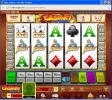
And this would be very easy for them to implement. In fact they have implemented it already. If you open any 5-reel slot at Betvoyager, it looks like this:
betvoyager3.webp

In this slot each reel has 30 symbols on it (some appearing more than once) so there are 30 different positions that any single reel can end up at. So when making a spin, the system just chooses a random position between 0-29 for each reel. Here you can see that there are FIVE shift values indicated at the top (one shift value for each reel) so to prevent tampering the player can shift any of the five reels by any amount. So it would be just a matter of implementing this same thing also in card games - very simple.

Binary128 said:
I think that congratulations to Jufo are in order here! :notworthy

Hip Hip Hooray! Hip Hip Hooray! Hip Hip Hooray!

I hope you are being sarcastic here because this is not exactly rocket science...

Binary128 said:
BUT ... (There's always a "but", isn't there.)

There are a few functional problems here.

1. These games would have to be created as separate Flash Files. I can't see any way around that. There would have to be a Stud Poker file that shows this interface, and another Stud Poker file that doesn't. For Galewind's relatively limited resources, this kind of sucks.

2. Because of this, the only games that you can "certify as clean" are the files that show this interface. The standard files would remain suspect.

3. This might prove to be a security nightmare. Flash files are easily cracked by the User. (I don't exaggerate when I say that different people have been "hack attacking" the server code pretty much every day for over 7 years.)

4. From a "server load" perspective, this is probably the least efficient way to use resources. Galewind currently doesn't "shuffle the deck". (Why have the CPU hit of a 416-card Pontoon shuffle to process a 4-card or 5-card game?) That would no longer work here - a full shuffle would be required. And each card selection represents a client-to-server call. So the current 2-call Stud Poker game (Deal + Raise) now goes to a 12-call game (Deal, 10 cards, Raise). (I have to think about shit like this.)

5. I understand the system, and I might play a little bit (a very little bit) with these games, but 99% of my play would be in the standard game files. (Of course, I might feel entirely different if I weren't playing my own software.)

6. For those that don't understand the system (more than 95% of the users?), they wouldn't touch these with a 10-foot pole.

I am glad that you finally (!) got there, ie. discussing the issues of implementing a similar system within another software. I am sure all those problem issues above are valid. Then again Slotmonster mentioned that Viaden is going to implement a similar system, so it doesn't seem entirely impossible.

Binary128 said:
But, shooting from the hip here, I'd have to conclude that, although this system is "A Really Great Idea", I'm not sure that it would pay back on the time and effort needed to build it. Given that Galewind is a "Level 5 Transparency" Casino, I remain unconvinced.

Yes, probably right. Then again with randomness control I am not sure how much auditing would be needed anymore, assuming that RC kind of takes care of that automatically. But no system is bullet-proof so I would assume that even Betvoyager does at least some monitoring and not just let the whole system run by itself for long periods of time. No one has ever brought up auditing of Betvoyager so it seems like people consider it unnecessary with RC. Of course having both RC and audits would be the best level of transparency.

Binary128 said:
BTW, given that we don't have any "Robots exclusion", "Pattern Betting exclusion", "Spirit of the Bonus exclusion", "Hacking the Game exclusion", or really anything like that in the T&Cs, does that make us a "Level 6 Transparency" Casino? :D

Chris, I can give you any level you want if you put some cash into my casino account :D Hehe, just joking. But to be fair, three of the above "exclusions" except the last one are directly related to "bonus abuse", so it's quite easy for you to say that none of those are issues at Galewind because you don't offer any bonuses anyway! So no points from those, Chris!

 
Last edited:
Can you guys please explain me why it is not enough just to cut every deck in card games?

Chris explained it to you very well already. Also consider the slot thing I posted above. In slots you can shift all five reels by different amounts, so it would only make sense that you would be able to do the same thing in card games (ie. choosing each card separately), right?

I am not saying that this is a major flaw in Betvoyager's RC. IMO it's a relatively minor thing. But I think it was worth bringing up that the system could be even slightly better than it is now.
 
The Randomness Control from BetVoyager is safe.

Theoretically it would be possible to find collisions (i.e. two different input texts result in the same hash code) by brute force (trying different server code words). Once they have found some collisions they could store these collisions in thier database and send them to the player whenever the player makes a big bet.

But practically this is with the current computer technology impossible. The SHA-256 algorithm can process around 100 MB/s on a 2 Ghz CPU. The SHA-256 hash has a length of 256 Bits, to find a collision for a 62 Byte long text like "spins : 2; server code word : 72f8800ed58fb220498e956292e35a9a" on a 2 Ghz CPU would need on average 1.086E+63 years ( ((2^256/2)/(104857600/62)/60/60/24/365) ). Also, the server code word is only 128 Bit long which make it difficult to find any collision on a 256 Bit long hash code.

However there might be vulnerabilities in the SHA-256 algorithm that are not discovered yet, which would make it possible to find collisions much quicker. Therefore to improve security I would recommend that the player can add his own code words in addition to the server code words.
 
Aha. And you call me long winded? You could have just posted:

Yes, seems like what I meant.

And we could have moved on. :D

Anyway, what I was trying to envision was a game interface where the actions of choosing your, and the dealers, cards was an enjoyable part of the game. Rather than selecting index numbers from drop-down lists, or some such system, the deck would be fanned across the table. (That's why a 6-deck or 8-deck shoe becomes a problem.)

I also thought that it would be nice if, when you clicked on a card in the fan, you saw what the card was at that time. (This part of the game is why it might prove to be a security nightmare.)

In other words, I was trying to design a game that incorporated your system but also approximated a real dealer dealing the cards, where you are the dealer. I think that something like this might actually be fun.

After all, games are supposed to be fun. Selecting 10 index integers from 10 drop down lists does not strike me as a whole lot of fun. As I said, after awhile it's "Enough of this shit, I just want to play some freakin' Pontoon."

The result would be that no matter how the deck was shuffled initially, you would be quaranteed to get a random and fair result, of course provided that you choose the indexes randomly enough yourself.

If the deck was properly "randomized", then I think your system would provide both a fair AND a random game regardless of the randomness of your choice of indexes.

In this slot each reel ...

I really only thought through the table card games and the video poker games, so I'm ill prepared to discuss how your system would best apply to slots. On this I take you at your word.

I hope you are being sarcastic here because this is not exactly rocket science...

I wasn't being sarcastic. It may not be rocket science, but it sure ain't 3rd grade math either. Until instructed otherwise, I will continue to refer to this as Your System.

I am sure all those problem issues above are valid.

Indeed they are, which is why I think that my previously listed "transparency steps" 1 through 5 remain necessary.

... three of the above "exclusions" except the last one are directly related to "bonus abuse", so it's quite easy for you to say that none of those are issues at Galewind because you don't offer any bonuses anyway! So no points from those, Chris!

I disagree. I think the only exclusion which isn't applicable without the "bonus model" is "spirit of the bonus".

I've read that Casinos don't want robots running as a "grind your way through the WR" tool. But I've also read they don't want robots running because of their "perfect play"; they want "human error" behind the client end. Which has nothing to do with bonuses.

(Of course, we've all read that the "robot exclusion" is just an "out clause" to not pay winners. I would have included this as just another chapter in the "Tin Foil Hat" codex but for the undeniable, and ongoing, history of this speculation proving true.)

I've never understood the "pattern betting exclusion" personally, but again I can't see your a --> b connection to bonuses.

So, I'd say that 3 out of the 4 that I listed still stand. I thus nominate Galewind Software for "Level 6 Transparency".

Chris
 
As for me, I am just a player like you. I don't work in the industry. I don't get paid for the posts I make about Betvoyager, or any posts for that matter. The stuff I posted is all my opinion as a player so I don't have the "working for competitor" position like SlotMonster or Chris here have, if that makes any difference for you.

I read a lot of yuor posts, Jufo, maybe all of them. They are not only sophisticated but easy to understand, they are also many-sided. Objectivity and fairness of your statements never made me think that you r one of 'them'. And if you still are, you must be one of the most delicate and diplomatic persons I've ever meat.
And, yes, it does make difference to me who I talk to. It is always interesting to learn, thats why I enjoy reading people like Chris or you, for instance. Just some things you take for granted, some things make you think in a new way, some things you get more sceptically. It all depends upon whether you speak to a genuin player or to an interested party.
 
Originally Posted by KotDaVinci :
"I could have made a couple mistakes on poker, but Punto Banco and AR - how could I misplay, thus having increased their house edge? And finaly, how could have I lost more than expected on Blackjack where I play better than basic strategy?"


Aren't you exagerating, bloke? How can you possibly play better?

No, I am not exaggerating. Basic strategy is called 'basic' because it can be improved with a card count. Otherwise it would be called optimal or ideal.
 
betvoyager

well....when it comes to betvoyager it is the best casino...they have true randomness control Sha-256 algorithm....and it is the best casino i have ever played at...and it is fair...which is most important..for online gaming
 

Users who are viewing this thread

Accredited Casinos

Read about our rating system and how it's done.
Back
Top