I've thought about it for a couple of days, and I've concluded that you may have created a truly viable solution here.
Stud Poker Example:
- The server creates a shuffled deck, keeps a master copy and a working copy, creates and sends you a checksum.
- You ante, and I "fan the deck" on the table, cards down.
- You mouse-over the fan, and click-select the cards that you want.
- Cards move to the Player Hand or Dealer Hand as clicked. (The card's "fan index number" follows the card on the table for later reference.)
- After both hands have their cards, you play through the game.
- When finished, I send you the master copy of the deck.
- You verify the checksum.
- You verify that the "fan index numbers" for the cards you see on your table match the ones that are in the deck.
Jufo - Yes? Have I understood you correctly?
I really think you may have hit on it. I think that this system would indeed guarantee that the game is not rigged. I've thought about it for 2 days now, and I can't see any holes in it. (See *** comment below.)
Yes, seems like what I meant. I'll give some screenshots below to illustrate it.
Let's choose Oasis poker at Betvoyager (very similar game to Caribbean Stud in your example above). You Chris (and anyone who is reading this) can open their own Oasis game from here (no need to register or anything) and test it themselves:
Old / Expired Link
It should be noted that the demo version is identical to the real money game with all the RC functions enabled.
From the top menu I choose arbitary cutting point of "9" and then deal my hand (your result will obviously differ from mine). I get a pair of Sevens versus Dealer Seven and obviously raise the hand. The result is:
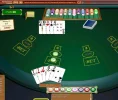
So dealer didn't qualify against my pair of 7's and I won amount equal to ante bet (here 10 euros).
Then I click the "V" symbol to see how the deck was shuffled. I get the following string:
"deck : 9d, Ah, As, 8d, 6h, 10s, Jc, Kd, Ac, Jh, Qs, 8c, 6c, 7c, 10c, 2s, 8h, 7d, 7s, 4s, 2h, 3h, 6s, 9h, 10h, 4d, Ad, 5c, Ks, 2c, Qd, 4c, 3d, 5h, 5d, 6d, 9c, Kh, 4h, 5s, Kc, 10d, Qc, 9s, 3s, Qh, Jd, 7h, 2d, 3c, 8s, Js; server code word : 027f0a60c5dd62b992420797c53781bb"
Below the result string (whose SHA-256 checksum you can always check) is the same information in graphical format:
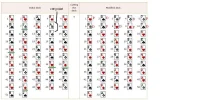
Now look at the right-hand side, which shows the deck being cut after 9 cards. Every second card is dealt to the player and every second to the dealer by the standard dealing procedures so I marked to the image each card that belongs to the player ("P") and to the dealer ("D). By comparing to the previous screenshot you see that the cards match with what I was dealt.
So this is how the system works now as it is. I can cut the deck at any point by assigining a number between 0-51 and player gets cards #1,#3,#5,#7,#9 and dealer gets cards #2,#4,#6,#8,#10 from that cutting point.
But
how I would like it for to work is that instead of choosing the cutting point only, I choose all the card indexes. For example if I chose that I want to get cards #7, #21, #34, #35 and #47, then I would have ended up cards that I marked with green underline in the left-hand part of the image (un-cut deck) and I would have ended up with JJ552. Of course I would have to choose the indexes for dealer's cards as well. I hope this clarifies it for you Chris, and this seems to be the same thing you wrote above.
The result would be that no matter how the deck was shuffled initially, you would be quaranteed to get a random and fair result, of course provided that you choose the indexes randomly enough yourself.
And this would be very easy for them to implement. In fact they have implemented it already. If you open any 5-reel slot at Betvoyager, it looks like this:

In this slot each reel has 30 symbols on it (some appearing more than once) so there are 30 different positions that any single reel can end up at. So when making a spin, the system just chooses a random position between 0-29 for each reel. Here you can see that there are FIVE shift values indicated at the top (one shift value for each reel) so to prevent tampering the player can shift any of the five reels by any amount. So it would be just a matter of implementing this same thing also in card games - very simple.
Binary128 said:
I think that congratulations to Jufo are in order here! :notworthy
Hip Hip Hooray! Hip Hip Hooray! Hip Hip Hooray!
I hope you are being sarcastic here because this is not exactly rocket science...
Binary128 said:
BUT ... (There's always a "but", isn't there.)
There are a few functional problems here.
1. These games would have to be created as separate Flash Files. I can't see any way around that. There would have to be a Stud Poker file that shows this interface, and another Stud Poker file that doesn't. For Galewind's relatively limited resources, this kind of sucks.
2. Because of this, the only games that you can "certify as clean" are the files that show this interface. The standard files would remain suspect.
3. This might prove to be a security nightmare. Flash files are easily cracked by the User. (I don't exaggerate when I say that different people have been "hack attacking" the server code pretty much every day for over 7 years.)
4. From a "server load" perspective, this is probably the least efficient way to use resources. Galewind currently doesn't "shuffle the deck". (Why have the CPU hit of a 416-card Pontoon shuffle to process a 4-card or 5-card game?) That would no longer work here - a full shuffle would be required. And each card selection represents a client-to-server call. So the current 2-call Stud Poker game (Deal + Raise) now goes to a 12-call game (Deal, 10 cards, Raise). (I have to think about s**t like this.)
5. I understand the system, and I might play a little bit (a very little bit) with these games, but 99% of my play would be in the standard game files. (Of course, I might feel entirely different if I weren't playing my own software.)
6. For those that don't understand the system (more than 95% of the users?), they wouldn't touch these with a 10-foot pole.
I am glad that you finally (!) got there, ie. discussing the issues of implementing a similar system within another software. I am sure all those problem issues above are valid. Then again Slotmonster mentioned that Viaden is going to implement a similar system, so it doesn't seem entirely impossible.
Binary128 said:
But, shooting from the hip here, I'd have to conclude that, although this system is "A Really Great Idea", I'm not sure that it would pay back on the time and effort needed to build it. Given that Galewind is a "Level 5 Transparency" Casino, I remain unconvinced.
Yes, probably right. Then again with randomness control I am not sure how much auditing would be needed anymore, assuming that RC kind of takes care of that automatically. But no system is bullet-proof so I would assume that even Betvoyager does at least some monitoring and not just let the whole system run by itself for long periods of time. No one has ever brought up auditing of Betvoyager so it seems like people consider it unnecessary with RC. Of course having
both RC and audits would be the best level of transparency.
Binary128 said:
BTW, given that we don't have any "Robots exclusion", "Pattern Betting exclusion", "Spirit of the Bonus exclusion", "Hacking the Game exclusion", or really anything like that in the T&Cs, does that make us a "Level 6 Transparency" Casino?

Chris, I can give you any level you want if you put some cash into my casino account
Hehe, just joking. But to be fair, three of the above "exclusions" except the last one are directly related to "bonus abuse", so it's quite easy for you to say that none of those are issues at Galewind because you don't offer any bonuses anyway! So no points from those, Chris!






 Quite a few things r illegal in Belarus but deffinitely not gambling