external image

Playtech rigged slots?

You have no legal expertise, so it is pointless going on about EU/UK Law because Playtech are not bound by them anyway (as you point out). I don't see a problem with having a shared database of fraudsters or any other undesirables.

Playtech is listed on the London stock exchange and is a FTSE 250 company. It is without any shadow of a doubt subject to UK law. They do have obligations to comply with the data protection act and if the database was as described, even if held by an overseas subsidiary and they used it and denied to the person in it that it existed then there is little doubt that they broke the the law and a complaint to the ICO would be upheld.
 
Playtech is listed on the London stock exchange and is a FTSE 250 company. It is without any shadow of a doubt subject to UK law. They do have obligations to comply with the data protection act and if the database was as described, even if held by an overseas subsidiary and they used it and denied to the person in it that it existed then there is little doubt that they broke the the law and a complaint to the ICO would be upheld.

You made my point for me.

I'm not a lawyer, so I was echoing what VWM said about PT not being subject to UK law. I didn't know either way.....either did he as it turns out.

I'm sorry if this has been asked already richas....are you a lawyer specializing in this kind of thing? I'm not being a dick....I'm genuinely interested as much of what you say makes sense.

So, why has nobody taken action regarding such a grievous breach of UK law? Seems odd, given that these databases are common knowledge. How would one prove that PT holds information about a player other than that required to create an account? What if it is run by an unrelated entity in another jurisdiction? What would constitute an "illegal database"? If a player is banned, and told he was on a 'fraud" database, what exactly does PT have to tell them? How about a "bonus deny" database such as Rival has across the whole platform.....if it just simply says "deny" and it is automatically done via a logarithmic process in the backend using data from all casinos, and is done within the scope of the privacy terms at each casino, is that illegal? Does PT have to reveal exactly how they work it out? After all, bonuses are not an entitlement under any law I've ever heard of, so isn't it just a business choosing with whom it wishes to do business?
 
I'm sorry if this has been asked already richas....are you a lawyer specializing in this kind of thing? I'm not being a dick....I'm genuinely interested as much of what you say makes sense.

So, why has nobody taken action regarding such a grievous breach of UK law? Seems odd, given that these databases are common knowledge. How would one prove that PT holds information about a player other than that required to create an account? What if it is run by an unrelated entity in another jurisdiction? What would constitute an "illegal database"? If a player is banned, and told he was on a 'fraud" database, what exactly does PT have to tell them? How about a "bonus deny" database such as Rival has across the whole platform.....if it just simply says "deny" and it is automatically done via a logarithmic process in the backend using data from all casinos, and is done within the scope of the privacy terms at each casino, is that illegal? Does PT have to reveal exactly how they work it out? After all, bonuses are not an entitlement under any law I've ever heard of, so isn't it just a business choosing with whom it wishes to do business?

I'm not a lawyer but I did get stuck with the job at my work of dealing with the data protection act when it was introduced OMG that was the 1994 one, I am getting too old. At the time I played a sort of sweeper role on all sorts of stuff. Once you have had to dig into something you tend to try and keep up with any changes.

There may be some way to outsource the operation but It does not absolve the UK company of their responsibilities and of course it is not just using a 3rd Party database that is the issue. The sites are sending information overseas even if it is just the name for them to check. This is the ICO page on that

Outdated URL (Invalid)

Having the database overseas does not get them off the hook. Indeed that may be the bit where they have broken the rules most clearly.

As described I can't see any way that it would be legal. Try this page - the example on a blacklist is fairly explicit (do find blacklist on the page)

Outdated URL (Invalid)

In the real world this is the closest example I know of
You do not have permission to view link Log in or register now.


As for why the ICO has done nothing about it...maybe they don't know. I am unsure that just being refused a potential bonus would constitute "damage or distress" and when you apply you likely give permission to basically do whatever they want with your data so it is possible that a single company using just their own database could do this but sharing and effectively blacklisting you with other companies would be hard to justify. Again I don't know the detail but as described it looks like they are breaking the rules.

My experience of contacting the ICO has been fairly positive. If you are on such a list or want to make a complaint about it to them I would say contact them, they are surprisingly helpful but I would also say spend a bit of time exploring their website first - it is a remarkably well put together site.
 
First of all, I'm sorry for the late response. I realize that this is not in context with the current state of the thread. However, this thread is moving faster than I can.

The minor corrective actions from the audit are the sort of thing I would have expected. It does suggest the close detail involved in the audit and does tend to suggest that what we have had reported here is in a different league to that sort of corrective action.

Yes, I would have to say that the Audit analysis of all of our games was very detailed and thorough.

I received daily status reports on their (SQS) progress. I believe that there were two SQS people (technicians) assigned to the analysis of our games. The daily status reports typically included results on 4 games. Thus, 1 technician was analyzing 2 games per day.

We would not have been approved for AGCC accreditation until all of the Minor Corrective Actions had been addressed, confirmed and accepted. Therefore, regardless of whether a specific Corrective Action had been given the weight of Critical, Major or Minor, approval by SQS/AGCC would have been denied while these issues still existed in the product.

I also agree that all of the issues which have been raised in this Playtech slots thread and in the Finsoft/Spielo G2 thread would have certainly resulted in "Corrective Actions", and it is my opinion that these Corrective Actions would have been weighted Critical or Major.

The re-certification examples in game operation that you have were very visible changes. They were important but they altered the defaults on entry or introduced new options - highly visible but not really a different game or a change in the likelihood or game operation. I can see that the cost of re-certification for these would seem (well be) burdensome for what in other industries would be a standard user interface enhancement.

The examples that I provided earlier for re-certification:

The Slot's "min coin amount, min coin count, max line count" and the Video Poker's "min coin amount, max coin count" - None of these changes modified the game's performance in any way. However, they did impact "Player expectations", specifically on entry into the game. Also, this new "default on load" system was documented in the Help files for all of the games (in the "How Do I Place a Bet?" section), so that also had to be verified. (These changes did not take a lot of time to re-certify.)

However, the changes to our slot console for available bet options, introduced here, were significant functional change to the entire bet system interface. That is, if I select the .25 chip and a chip count of 3 (for a payline bet of 0.75), do any/all payline win amounts accurately reflect the win multiplier in the paytable times the 0.75 payline bet? (These changes took 2 days to re-certify.)

As for the RNG re-certification of October 3 2011, this was done long before the AGCC/SQS Audit. In this case, re-certification fell under the requirements documented by iTech Labs.

I provided this in my post as an example of a "hidden change". No one else on the planet was aware, nor would ever be aware unless we told them, that we changed the "background cycling system" of the RNG process.

However, rather than viewing re-certification by iTech Labs as just some "procedural bullshit", I viewed it as an important "final inspection and approval" step. So I ponied up the buckazoids and sent the new system off to the lab for a full set of tests.

I'd like to mention - I also view our monthly game analysis, with RTP report, from Certified Fair Gambling (CFG) in the same light. This is not just some "procedural bullshit" that we go through for the sake of satisfying some certification requirement. I view CFG as an important part of our Quality Assurance systems.

Yes, as thePOGG has pointed out, it is a "paid for analysis". But if I had an employee on staff doing the same thing each month, then:

1. I would also pay them for the work.

2. Anyone I might hire for this work would know a hell of a lot less than CFG on what to do and how to do it.


This leaves me thinking that there is a high cost in time and money to recertify and so there is a big incentive to not recertify for less visible but potentially far more significant changes to the game play and rtp. If the help file is unaltered and if the game play looks the same then not recetifying is attractive. This also seems to provide an incentive to have less helpful help files - the less info they have in them the less likely they are to change and so make some other change visible and thus more clearly requiring the expensive recertificaton.

If this speculation has some truth to it then we have a perverse incentive driven by the regulatory recertification cost to provide as little game description as possible, to avoid visible change and avoid informing players of changes to the gameplay, rtp and potentially optimal strategy not so much to deceive players as to avoid triggering recertification.

A valid, although really cynical, point. :rolleyes: Regardless, it's far too late for us (although we do have the possible out that very very few people read what we publish).

Is there any guidance (beyond touching the RNG) on when recertification is required?

Yes, there is extensive "guidance" here. If you re-read what I've written above, you'll see that re-certification is required for some relatively minor things. I can guarantee you that re-certification is required for anything further up the scale in terms of game changes (both visible and not visible).

Again, I don't view any of this as just "procedural bullshit" - a waste of time and/or money. I view it as an important part of our Quality Assurance systems, protecting the Player, the casino and the software provider.

Chris
 
A valid, although really cynical, point. :rolleyes: Regardless, it's far too late for us (although we do have the possible out that very very few people read what we publish).

Yes, there is extensive "guidance" here. If you re-read what I've written above, you'll see that re-certification is required for some relatively minor things. I can guarantee you that re-certification is required for anything further up the scale in terms of game changes (both visible and not visible).

Thank you again for your time in responding to this. I do try to fight down my cynical demons but what you have said about the extensive guidance about when recertification is required only makes me more confident that the problem here is not really about play games differing from real - even though that is a clear regulatory breach both for it existing and how it got there (poor change control/quality control). That is a symptom of other failures. To me it is about

1) changes to games that should involve recertification but where recertification is avoided
2) a common industry practice of failing to describe the game and likelihood of winning as already required that makes 1) easier.

Players should be told if the game changes. That really is not a demanding regulatory or ethical requirement.

I don't buy that there is some conspiracy to defraud/deceive - cock up is always more likely than conspiracy but we have had weeks of accepted and certain cock up. Even without full disclosure I am impatient enough to be looking at solution mode and for me that is the regulator enforcing some reasonable disclosure on likelihood of winning an how the game determines winners and the regulator making changes to game play and likelihood of winning certain requirements of recertification (which to be honest I think they are anyway but some avoid it).

To me it looks like increased insistence from the regulator on these issues would have zero impact on how Galewind operates.

I don't demand blood on the floor over breaches in regulation but this is looking more and more like a systematic failure of recertification made possible by a systematic failure to describe game play and likelihood of winning/determining the award of prizes - something that is supposed to be required.

To me it looks like an industry where today most providers are cocking up and time for the regulator to kick butt on the issue to restore confidence.
 
I don't buy that there is some conspiracy to defraud/deceive - cock up is always more likely than conspiracy but we have had weeks of accepted and certain cock up. Even without full disclosure I am impatient enough to be looking at solution mode and for me that is the regulator enforcing some reasonable disclosure on likelihood of winning an how the game determines winners and the regulator making changes to game play and likelihood of winning certain requirements of recertification (which to be honest I think they are anyway but some avoid it).

I don't demand blood on the floor over breaches in regulation but this is looking more and more like a systematic failure of recertification made possible by a systematic failure to describe game play and likelihood of winning/determining the award of prizes - something that is supposed to be required.

To me it looks like an industry where today most providers are cocking up and time for the regulator to kick butt on the issue to restore confidence.

I think that at least part of what we're seeing here is the natural and expected confusion that arises as a result of "fundamental changes to the way things work".

Casinos, software providers and Regulatory agencies are going to have to get used to the fact that at some point they'll actually need to do what is documented in all of these standards.

Obviously, eCOGRA led the way here, and as I understand it eCOGRA continues to provide (extensive?) consulting services to these newer Regulatory agencies.

Experienced consulting input is a great help in generating a Regulator's "Battle Plan". However, it is up the Regulatory agencies to "put, and keep, trained troops in the field to implement that Battle Plan". Otherwise, this Plan is just words on paper, and nothing has really changed.

In a previous post I was talking about the advantages of working with Certified Fair Gambling because Eliot Jacobson comes from the Casino world.

About CFG I had this to say:

You're not force fitting some generic Quality System Standard (ISO 9000 and their ilk) onto the very special case of online Casinos. I really can't think of any other market where some (many?) of the businesses are actively trying to steal money from their customers, and some (many?) of the customers are actively trying to steal money from the businesses.

I think that unless you approach that market, and the auditing of that market, with that perspective, and the detailed knowledge and experience required to deal with it, well then you're just attempting to shoehorn the same control systems onto online gambling as one might apply to the manufacture of door hinges.

Given that the history of this industry is ...

- non-disclosure as Standard Operating Procedure.

- the software providers generally do not have any responsibility for their licensees.

- the software providers generally remain hidden behind those licensees.

- game performance information is limited to what you can find on reference web sites (like the WizardOfOdds).

... I'm sure that one of the biggest challenges in writing up these new regulatory standards was dealing with the question - "Given what we're starting with, just how far do we go?" Shooting for the stars is well and good, but a more Earth-bound target has a higher probability of being hit.

So some of the language is not crystal clear and definitive, leaving all parties with a little bit of "wiggle room".

I'll end as I started - I think that at least part of what we're seeing here is the natural and expected confusion that arises as a result of "fundamental changes to the way things work".

Chris
 
I don't buy that there is some conspiracy to defraud/deceive - cock up is always more likely than conspiracy but we have had weeks of accepted and certain cock up. Even without full disclosure I am impatient enough to be looking at solution mode and for me that is the regulator enforcing some reasonable disclosure on likelihood of winning an how the game determines winners and the regulator making changes to game play and likelihood of winning certain requirements of recertification (which to be honest I think they are anyway but some avoid it).

To me it looks like increased insistence from the regulator on these issues would have zero impact on how Galewind operates.

I don't demand blood on the floor over breaches in regulation but this is looking more and more like a systematic failure of recertification made possible by a systematic failure to describe game play and likelihood of winning/determining the award of prizes - something that is supposed to be required.

To me it looks like an industry where today most providers are cocking up and time for the regulator to kick butt on the issue to restore confidence.

I don't buy this as a conspiracy either, but i do think that it goes beyond cock up well into the realms of wilful negligence (or burying your head in the sand for a less emotive turn of phrase).

Over the two separate issues, separate but convergent problems arise. With FinSoft you have a huge game supply company that has made no effort what-so-ever to familiarise itself with the basic principles of online gambling or the licenses' of its clients.

With Betfred (and others to one degree or another) you have a group that has actually shown a fair level of contempt for its players. I'm sorry Aaron, this is in no way intended as a personal attack, but the last statement released was actually appalling. In refusing to acknowledge evidence not gathered by 'supplier approved' testing they've both demeaned the hard work of the people involved in gathering evidence and instilled an obvious conflict of interest. The company who's integrity is being investigated are the same body being allowed to decide which evidence is admissible - this certainly appears to allow aspects of this situation that are inconvenient to be ignored. Case in point would be the Aladdin's treasure game, where in a half hour of testing by anyone at their end would be enough to prove the issue and given the attention it's received if the supplier were in any way interested in acknowledging this issue they would have demanded testing by this point. But instead this breach of license has been ignored as the original evidence wasn't submitted by a 'supplier approved' testor.

Then we have Playtech. If you fundamentally change the game away from the standards it was originally meant to meet, then of course you are going to need to get the game retested. It's fairly straight forward stuff - if i put my new car design in for emissions testing, then i change the way the engine works, of course i'm going to have to have the emissions testing done again.

But the truth of this is that all of these points are convergent in one area and that is a lack of discipline. If as a teacher i allow my class to call me 'Mr T' or swear this week trying to get them to stop next week is far more difficult than simply having not let it happen in the first place. The GRA have maintained a good reputation as online gambling regulators go for showing greater commitment to handling player complaints than their peers (for which they should be commended), but they haven't been enforcing all the terms of their license, making these rule about testing, real devices and free play games rules in writing only. They are now left with an unenviable choice; they either have to find a way to enforce their terms as written, not just to the parties involved, but across all their licensees or allow themselves to appear to be just another regulator in name only. And both of these may have largely unpleasant consequence. If they decide to enforce these rules it will undoubtedly create a massive additional workload in the short term making all of their licensees aware of the new standards and putting in place all of the procedures to ensure they remain in place. In fact i would suggest this may be a massive additional workload in the long term as well, on a government department that is likely small. Alongside this, retesting games when changed and meeting the other regulatory requirements is likely to cost their licensees a substantial amount when they could just move to another regulator that has not started enforcing these terms. Taking a harder line could potentially dramatically affect the GRA's client list. If they choose the other route, that of non-enforcement, they lose credibility with players making their license less valuable to their licensees and ultimately may also face some political backlash.

To sum it up, the GRA's slow manoeuvring in this case is likely due to the fact that they don't have any 'good' choices. When no good options exist, it's human nature to be far less decisive.
 
Last edited:
I don't buy this as a conspiracy either, but i do think that it goes beyond cock up well into the realms of wilful negligence (or burying your head in the sand for a less emotive turn of phrase).

With all of these documented regulations being brought before our eyes by Richas, I think it's obvious that all business parties currently under discussion have indeed "buried their heads in the sand." But I also think that's just a "standard bureaucratic response" to change - you only do what you need to do when you need to (or are forced to) do it. Until that time, you just ignore it, or pay it lip service.

I made a post on another forum, but it's worth repeating here. There is a Wikiquote page on Politics. On there, under the label "Government bureaucracy",
You do not have permission to view link Log in or register now.
:

Wikiquote said:
Politics is the art of postponing decisions until they are no longer relevant.


Over the two separate issues, separate but convergent problems arise. With FinSoft you have a huge game supply company that has made no effort what-so-ever to familiarise itself with the basic principles of online gambling or the licenses' of its clients.

I think that's a general truth of the current state of the industry. In the (new) 3-legged stool that represents the public interface of online casinos (Players, Casinos, Regulators), the only one that really knows what's going on is the Player. And I think the reason that the Player knows what's going on is because the Player NEEDS TO KNOW what's going on.

I confess, however, that I was surprised at the following post:

Our investigation of the two games in question (Ugga Bugga and Ocean Princess) shows that there was a difference in the RTP between the real play version and the free-play version. We have raised this with the supplier, Playtech, and they agree with our analysis and are deploying a fix, estimated for this coming Monday.

The implication of these 2 sentences is that Betfred needed to do work ("Our investigation ...") in order to get the Software supplier involved in the problem. A simple phone call wasn't enough. (Yes, these 2 sentences may have also been "tactful phraseology" on the part of Aaron (aka, "spin"), and a phone call was all that was actually done.)

In refusing to acknowledge evidence not gathered by 'supplier approved' testing they've both demeaned the hard work of the people involved in gathering evidence and instilled an obvious conflict of interest. The company who's integrity is being investigated are the same body being allowed to decide which evidence is admissible - this certainly appears to allow aspects of this situation that are inconvenient to be ignored.

Or, if you'll pardon the crude reference, it could also just be your "standard bureaucratic CYA response" in the face of a possible "shit storm" on the horizon.


But the truth of this is that all of these points are convergent in one area and that is a lack of discipline.

I said in my last post - "I think that at least part of what we're seeing here is the natural and expected confusion that arises as a result of 'fundamental changes to the way things work'." Change is always tough in any "bureaucratic system". Once change stops, the "new way" simply transforms into "the way things are done". In this instance, one of the ramifications of these new regulations would certainly require the application of more discipline.

Re:
The GRA have maintained a good reputation as online gambling regulators go for showing greater commitment to handling player complaints than their peers (for which they should be commended) ...

Have you got any data for that? I would be very interested if you do. I've exchanged a number of emails with a "Gambling Monitor" (I think that's a position title) of the Gibraltar Gambling Commissioner. They've indicated that these sorts of things (complaints, their existence, their details, etc.) are not considered "public records" of the Gibraltar government, available on just a simple request. All of this stuff is considered "private records".

They are now left with an unenviable choice; they either have to find a way to enforce their terms as written, not just to the parties involved, but across all their licensees or allow themselves to appear to be just another regulator in name only. And both of these may have largely unpleasant consequence. If they decide to enforce these rules it will undoubtedly create a massive additional workload in the short term making all of their licensees aware of the new standards and putting in place all of the procedures to ensure they remain in place. In fact i would suggest this may be a massive additional workload in the long term as well, on a government department that is likely small. Alongside this, retesting games when changed and meeting the other regulatory requirements is likely to cost their licensees a substantial amount when they could just move to another regulator that has not started enforcing these terms. Taking a harder line could potentially dramatically affect the GRA's client list. If they choose the other route, that of non-enforcement, they lose credibility with players making their license less valuable to their licensees and ultimately may also face some political backlash.

Agreed, it is a tightrope. Then, in thinking about it for a bit, the expression "tangled web" crossed my mind.


To sum it up, the GRA's slow manoeuvring in this case is likely due to the fact that they don't have any 'good' choices. When no good options exist, it's human nature to be far less decisive.

Agreed. I think all of the answers to all of the public questions (and I'd hazard a guess that answers to questions which have not yet become public) - I think all these answers are already available, and I think that all of them basically suck. Multiple deployments of "gaffed games" going back for years, multiple deployments of Play-for-Fun != Play-for-Real going back years, and so forth.

This is also the type of thing that has the potential for a "Snowball Effect". Players with their bits of data, otherwise standing on the sideline, suddenly bring those bits of data to light. Old complaints that went nowhere at the time are suddenly resurrected. And so forth.

Chris
 
Have you got any data for that? I would be very interested if you do. I've exchanged a number of emails with a "Gambling Monitor" (I think that's a position title) of the Gibraltar Gambling Commissioner. They've indicated that these sorts of things (complaints, their existence, their details, etc.) are not considered "public records" of the Gibraltar government, available on just a simple request. All of this stuff is considered "private records".

Ah you caught me! lol

I have absolutely no evidence to support that claim, it was simply a heuristic judgement based of the lack of complaints i've seen and the general good reputation they seem to have with players. For me this seems to be the first time they've really be tested, so when (if?) they come to a conclusion and publish it, i'll be very interested to see.
 
Ah you caught me! lol

I have absolutely no evidence to support that claim, it was simply a heuristic judgement based of the lack of complaints i've seen and the general good reputation they seem to have with players. For me this seems to be the first time they've really be tested, so when (if?) they come to a conclusion and publish it, i'll be very interested to see.

thePOGG,

That wasn't really a "gotcha" question. I'm thinking that if the (new) Regulatory agencies are requiring greater transparency from those casinos/software providers that they certify, then shouldn't the Regulatory agencies also provide a certain level of transparency?

I don't exactly know, because I've never looked, but I'm pretty sure that my local police provide a lot of information on things they do, complaints to which they respond, cases that they investigate, and so forth.

It seems to me that the GRA, AGCC, and others should provide at least summary information for each of the companies that they certify. The number of Player complaints, the amount of money involved in that complaint, a brief summary (100 words or less) about the complaint, the resolution of the complaint, and a brief summary (100 words or less) of the logic that was used to make this decision.

The certified companies are public if for no other reason that they are listed on the GRA (or AGCC) web site. The Players are not "public", therefore it seems to me that there would be neither justification nor value in disclosing any information about them.

Who certifies the certifiers?

Chris
 
Just to chime in here real quick. I do not appreciate how a number of members are coming to conclusions without all of the evidence. This is called speculation. I don't mind people speculating because that's a normal part of a conversation or debate. But speculations are not facts - don't treat them as such. Just because you think something is so - doesn't mean that it is true.

Feel free to debate, but if you attack igaming reps (like Betfred), then you've crossed the line. And if you are doing this to undermine their company - or to damage their company making false statements, you can be held liable. Do not abuse this forum by pushing personal agendas.

@vwm - I have not a clue what you're talking about when you say that Playtech lied to me. I have a relatively good relationship with this company; if you are making comments like this, I'd appreciate a bit of tact because what you said is groundless.
 
thePOGG,

That wasn't really a "gotcha" question. I'm thinking that if the (new) Regulatory agencies are requiring greater transparency from those casinos/software providers that they certify, then shouldn't the Regulatory agencies also provide a certain level of transparency?

I don't exactly know, because I've never looked, but I'm pretty sure that my local police provide a lot of information on things they do, complaints to which they respond, cases that they investigate, and so forth.

It seems to me that the GRA, AGCC, and others should provide at least summary information for each of the companies that they certify. The number of Player complaints, the amount of money involved in that complaint, a brief summary (100 words or less) about the complaint, the resolution of the complaint, and a brief summary (100 words or less) of the logic that was used to make this decision.

The certified companies are public if for no other reason that they are listed on the GRA (or AGCC) web site. The Players are not "public", therefore it seems to me that there would be neither justification nor value in disclosing any information about them.

Who certifies the certifiers?

Chris

Who certifies the certifiers of the certifiers?

At some point, the buck has to stop.

The only way it is going to stop is if players vote with their cash, stop playing online, or only play where there is a solid, government-regulated regime in place. Unfortunately, not nearly enough people give a toss enough to bother. You only have to look at the couple of threads here like this one, where it is really only a comparative handful of members who are really interested and passionate enough about regulation etc to participate, and most likely don't read past the first page or the first post, particularly if there are 27 other pages to read.

It's sad, but it's the way things are.

No regulator or operator is ever going to change anything until it starts costing them real money, save for a few ethical ones who can see the bigger picture.

We can debate it until we're blue in the face, but at the end of the say we are a tiny ripple in a gigantic pond that only a handful of people are watching closely enough to see.
 
Who certifies the certifiers of the certifiers?

At some point, the buck has to stop.

The only way it is going to stop is if players vote with their cash, stop playing online, or only play where there is a solid, government-regulated regime in place. Unfortunately, not nearly enough people give a toss enough to bother. You only have to look at the couple of threads here like this one, where it is really only a comparative handful of members who are really interested and passionate enough about regulation etc to participate, and most likely don't read past the first page or the first post, particularly if there are 27 other pages to read.

It's sad, but it's the way things are.

No regulator or operator is ever going to change anything until it starts costing them real money, save for a few ethical ones who can see the bigger picture.

We can debate it until we're blue in the face, but at the end of the say we are a tiny ripple in a gigantic pond that only a handful of people are watching closely enough to see.

Unfortunately Nifty, I think you're absolutely right.

I suppose gamblers are, by definition, not necessarily always the most rational and objective bunch of people - and the rogue element of the casino industry knows that, and plays on it mercilessly.
 
Just to chime in here real quick. I do not appreciate how a number of members are coming to conclusions without all of the evidence. This is called speculation. I don't mind people speculating because that's a normal part of a conversation or debate. But speculations are not facts - don't treat them as such. Just because you think something is so - doesn't mean that it is true.

Feel free to debate, but if you attack igaming reps (like Betfred), then you've crossed the line. And if you are doing this to undermine their company - or to damage their company making false statements, you can be held liable. Do not abuse this forum by pushing personal agendas.

@vwm - I have not a clue what you're talking about when you say that Playtech lied to me. I have a relatively good relationship with this company; if you are making comments like this, I'd appreciate a bit of tact because what you said is groundless.

I will clarify.

During a debate regarding Playtech, you stated that you had visited Playtech's offices in the Philipines. You then corrected this after being told that Playtech had no offices there, and never had. You semed to have been told this by Playtech via an intermediary. Playtech claimed that you had merely seen the offices of one of their operators. In fact, Paragon International Customer Care was NOT an independent operator, but part of Playtech itself. It merely had a company structure designed to put distance between Playtech itself and it's white label operation. The company reports filed in the UK show the facts about the relationship. Paragon International Customer Care was initially set up by the majority owner of Playtech, but was in effect wholly controlled by Playtech through voting rights and board membership. Playtech also had the option to take formal control by buying out the other shareholders, mainly Playtech's founder and part owner. This eventually happened.

This debate arose from various tales from players that made it clear that many supposedly independent Playtech operators seemed to have full access to players' personal information across the entire software platform. This would never happen in a truly competitive environment, it would be like 32Red having details of players at All Slots, and information at a level that would enable them to determine the potential revenue from that player before they had even placed their first bet. Paragon also operate the notorious "abuser database", which seems to be populated by operators sending information that a specific player is of "negative worth" because of their playing style, which other operators can use to decide that a new player they attract might as well be given the boot. This has now been confirmed as fact by the Grand Duke rep.

The other obvious indication was the stream of complaints from players who were asked to send their documents to this Philipines company directly, NOT to the offices of the operator concerned. In the request, the company was not named, but if pressed, players were told that they were sending the documents "to Playtech" rather than the operator as this is where the security checks were done. This stuck out like a sore thumb because the operators involved showed no signs of being connected to an operator in the Philipines. Some that asked players to send documents to the Philipines were licenced by the likes of the GRA, and had well known UK brands. Players were obviously alarmed because the company was not named, it was in the Philipines rather than where the casino was licenced or ran it's support centre, and of course Playtech has not, and never has had, offices in the Philipines.

I identified the name of the company because they put a recruitment ad on the internet - in English, looking for local staff, presumably in Manila.

It would appear that Playtech actually have an operation similer to that of Rival, running a large number of branded skins as white labels from the Philipines. Despite being advertised to players as independent, like the Rival white labels, they are not, they are one big operator, and players are actually playing at a number of casinos in the same group. The problem is one of dishonesty. Players are told the skins are independent, but they are then "punished" because they are treated as though they are playing at a single group, and somtimes get winnings confiscated for effectively having "too many accounts with the group", similar to the problems players have with the Cassava skins, and the Bonne Chance Rivals.

I suspect that the Paragon setup is designed to allow Playtech to be an operator, not just a software provider, but like Rival, uses subsidiaries to hide the connection. Unlike Rival, who also use the setup to hide the ultimate owners, Playtech have to be more open because they are listed on the stock exchange, so have to publish the details in their annual report. It is not a document that the vast majority of players will read, so they can publish something there, yet players may have no idea about it for some years. It seems the connection between Playtech and Paragon appears in company reports from around 2004, long before any of this became an issue in the forums.

I call it a lie because what Playtech said was carefully worded to deceive players who wanted answers to the questions about the "abuse" database and the reason for all their documents ending up in Manila.

"Playtech don't have offices in the Philipines" is technically correct, but substantively a lie. It's because they use a subsidary holding company with a different name, rather than running the operation as a department of the parent company.

"Playtech does not operate an abuser database" is also technically correct, and for the same reason - they run it under the name of their subsidiary.

This does not alter the fact that despite various denials, this abuser database exists, and is freely available to all Playtech operators. For the documents issue, Playtech would have been better off admitting that this was a Playtech office in the Philipines, and that players were merely having their documents checked "in house" by the software provider, rather than the individual operators.

This does not prove that vast numbers of their slots are rigged, but it shows that they intentionally mislead end users as to the true nature of who the operators they are dealing with are, who is having access to your personal information, and how it is being used. It implies that we shouldn't take their word for it over this issue, as they are not suddenly going to change the habit of a lifetime and give a full and transparent account of the matter. They will only want to give out what they feel they can get away with.
 
I will clarify.

During a debate regarding Playtech, you stated that you had visited Playtech's offices in the Philipines. You then corrected this after being told that Playtech had no offices there, and never had. You semed to have been told this by Playtech via an intermediary. Playtech claimed that you had merely seen the offices of one of their operators. In fact, Paragon International Customer Care was NOT an independent operator, but part of Playtech itself. It merely had a company structure designed to put distance between Playtech itself and it's white label operation. The company reports filed in the UK show the facts about the relationship. Paragon International Customer Care was initially set up by the majority owner of Playtech, but was in effect wholly controlled by Playtech through voting rights and board membership. Playtech also had the option to take formal control by buying out the other shareholders, mainly Playtech's founder and part owner. This eventually happened.

This debate arose from various tales from players that made it clear that many supposedly independent Playtech operators seemed to have full access to players' personal information across the entire software platform. This would never happen in a truly competitive environment, it would be like 32Red having details of players at All Slots, and information at a level that would enable them to determine the potential revenue from that player before they had even placed their first bet. Paragon also operate the notorious "abuser database", which seems to be populated by operators sending information that a specific player is of "negative worth" because of their playing style, which other operators can use to decide that a new player they attract might as well be given the boot. This has now been confirmed as fact by the Grand Duke rep.

The other obvious indication was the stream of complaints from players who were asked to send their documents to this Philipines company directly, NOT to the offices of the operator concerned. In the request, the company was not named, but if pressed, players were told that they were sending the documents "to Playtech" rather than the operator as this is where the security checks were done. This stuck out like a sore thumb because the operators involved showed no signs of being connected to an operator in the Philipines. Some that asked players to send documents to the Philipines were licenced by the likes of the GRA, and had well known UK brands. Players were obviously alarmed because the company was not named, it was in the Philipines rather than where the casino was licenced or ran it's support centre, and of course Playtech has not, and never has had, offices in the Philipines.

I identified the name of the company because they put a recruitment ad on the internet - in English, looking for local staff, presumably in Manila.

It would appear that Playtech actually have an operation similer to that of Rival, running a large number of branded skins as white labels from the Philipines. Despite being advertised to players as independent, like the Rival white labels, they are not, they are one big operator, and players are actually playing at a number of casinos in the same group. The problem is one of dishonesty. Players are told the skins are independent, but they are then "punished" because they are treated as though they are playing at a single group, and somtimes get winnings confiscated for effectively having "too many accounts with the group", similar to the problems players have with the Cassava skins, and the Bonne Chance Rivals.

I suspect that the Paragon setup is designed to allow Playtech to be an operator, not just a software provider, but like Rival, uses subsidiaries to hide the connection. Unlike Rival, who also use the setup to hide the ultimate owners, Playtech have to be more open because they are listed on the stock exchange, so have to publish the details in their annual report. It is not a document that the vast majority of players will read, so they can publish something there, yet players may have no idea about it for some years. It seems the connection between Playtech and Paragon appears in company reports from around 2004, long before any of this became an issue in the forums.

I call it a lie because what Playtech said was carefully worded to deceive players who wanted answers to the questions about the "abuse" database and the reason for all their documents ending up in Manila.

"Playtech don't have offices in the Philipines" is technically correct, but substantively a lie. It's because they use a subsidary holding company with a different name, rather than running the operation as a department of the parent company.

"Playtech does not operate an abuser database" is also technically correct, and for the same reason - they run it under the name of their subsidiary.

This does not alter the fact that despite various denials, this abuser database exists, and is freely available to all Playtech operators. For the documents issue, Playtech would have been better off admitting that this was a Playtech office in the Philipines, and that players were merely having their documents checked "in house" by the software provider, rather than the individual operators.

This does not prove that vast numbers of their slots are rigged, but it shows that they intentionally mislead end users as to the true nature of who the operators they are dealing with are, who is having access to your personal information, and how it is being used. It implies that we shouldn't take their word for it over this issue, as they are not suddenly going to change the habit of a lifetime and give a full and transparent account of the matter. They will only want to give out what they feel they can get away with.

So, "technically correct" means "lie" when you want it to, but other times "technically correct" is "absolutely correct".

You're a man who insists on precision and "the law". If it is "technically correct", then it IS correct, and hence NOT a lie/deception. More speculation.

FWIW, here is an excerpt from a few PT casinos terms and conditions:

We may disclose (and you agree that we may do so) your personal information to any subsidiaries or associated companies and selected third parties with whom we have contractual relationships (including but not limited to suppliers and service providers).

So, what's the problem? If one doesn't want their information shared, they should not create an account....or are you going to tell me it is all "illegal" and that "the courts would never allow it" etc etc.

You stated PT lied to Bryan. It's a very serious accusation, and nothing you have said supports it.
 
Some things here! An important question, where can we read about Playtech's denial of office in Manila? :confused: I have searched a lot now. What we do now is that there is an office in Manila and that Playtech owes it 100%.

From CM Newsletter feb 2007:

Pacific Congress on I-Gaming It's being held at the Mandarin Oriental Hotel in Macau 26-27 February. I heard that the catering is supposed to be pretty good, so I'm flying out there tomorrow to see if this is true. Actually, I'll be in Hong Kong for a couple of days beforehand to get my sea-legs. And after the conference, I'll be checking out the Playtech offices in Manila. So this means you, my dear ${token2}, can anticipate a bitchin' report on Casinomeister's Asian trek. Stay tuned for that one.

From Newsletter mars 2007:

The following day I was given a tour of the Playtech "live games" office in Manila. A number of you readers may have played these games - playing Blackjack, Roulette, or Baccarat with a young attractive female dealer. These girls are positioned at each table with a camera recording their card action and wheel spinning. It's one thing to see them in action online, but to actually be there behind the scenes was impressive. It's very interactive with the girls being able to "chat" with their players (when traffic isn't so heavy) and there is constant monitoring and supervision going on. I could see how this could be stressful for the girls; they have to smile all the time and look perky, so they are afforded frequent breaks. It must be a nice job though, since players are able to tip the dealers if and when they win. I'm sure this is most appreciated.

From Aug 2011:

Eh!

I was "set straight" about this, and so was Bryan. We were told that this was NOT Playtech, but a different company. The address the OP was told to send documents to comes back as "Paragon Intl Customer Care Limited", rather than "Playtech".

So, if Playtech say "we don't have access to Player's data" - it's a load of bollocks - it is all at "their office in Manila" that they don't have:rolleyes:

I don't blame you, this is Playtechs bullshit.


If Playtech still claim not to have an office in Manila, they are calling plexrep a liar.

A chance here for Playtech to cut the crap and tell the truth, as well as stop pretending they have no influence over rogue operators because "we only supply the software".

From sep 2012:

It was "revealed" in a prospectus (related to them being upgraded to the London Stock Exchange's main market) document published in June or July this year, that this company is owned by Playtech.

Paragon is listed as 100% owned by Playtech on page 114 in that document with this info:


Paragon International Customer Care Limited - British Virgin Island and branch office in the Philippines

100% English customer support, chat, fraud, finance, dedicated employees services to parent company

Especially this quote from VWM is important:

I was "set straight" about this, and so was Bryan. We were told that this was NOT Playtech, but a different company.
 
It seems to me that the GRA, AGCC, and others should provide at least summary information for each of the companies that they certify. The number of Player complaints, the amount of money involved in that complaint, a brief summary (100 words or less) about the complaint, the resolution of the complaint, and a brief summary (100 words or less) of the logic that was used to make this decision.
Chris

I am not that bothered about this sort of disclosure re complaints. Stats on that sort of thing are easy to abuse and difficult to present fairly. In addition individual complaints might involve confidential information.

The UKGC requires that a licenced site appoint a third party, independent, arbitrator with some expertise. This body has to be approved by the UKGC. This approach seems to make more sense re complaints and disputes than summarising numerous complaints and their resolution. A zero cost (to player) independent arbitrator seems far better to me than complaint publication requirements.

The goal is fairness to the customer and a fair process with binding outcomes on the site. Publishing the data on fair resolutions whilst maybe interesting is not the main event. Today failure to deal properly with this sort of thing is a good flag on sites to avoid but far better to rise the standards of all sites to make that measure moot.
 
Talk about splitting hairs. :rolleyes: These were the offices of Playtech operators - and a company that provided a few Playtech operators their live games. I really can't be bothered with this. You have way too much time on your hands. I wish you spent it doing something else.
 
My phrase "Who certifies the certifiers" was a play on words. The phrase to which it refers - "who polices the police" - was in the title
You do not have permission to view link Log in or register now.
from April of 1965. (The phrase could go back further than 50 years - I only did a quick search - but it has certainly been used many, many times since then.)

When used, this "police phrase" was not spoken facetiously or pedantically (as in overly concerned with unimportant details). Indeed, quite the opposite. It was typically spoken at those times when significant police corruption was under investigation. (The 1965 Time article dealt with civil rights abuse. To quote: "The fuss is about ... a series of Negro complaints about mistreatment by white policemen")

In addition, neither the question nor the need for an answer was ignored. Police departments created Internal Affairs divisions. The Time magazine article I referred to concerned a "civilian review board". And so forth.

So, in short, the question "Who polices the police" was seriously asked, and its asking was not considered rhetorical or superfluous (as in unnecessary or more than required).


As to the potential impact of this thread, or other Casinomeister threads, on the issues at hand - I'm reminded of something that Bryan said earlier:

"I'm not about to put this site in jeopardy to appease those few who want blood."

I believe that Bryan makes it very clear here (and in his earlier post from today) that statements or conclusions, even speculation or extrapolation, about these subjects represents the potential for (serious?) harm to this, Bryan's, web site. That strikes me as some major damage from a tiny ripple.


From dictionary.reference.com:

- The definition of jeopardy (within a legal context): "the danger or hazard of being found guilty, and of consequent punishment, undergone by criminal defendants on trial."

- The definition of speculation (as a noun): "the contemplation or consideration of some subject", with synonyms: supposition, view, theory and hypothesis.

- The definition of speculating (as a verb): "to indulge in conjectural thought", with synonyms - think, reflect, cogitate, conjecture, guess, surmise, suppose, theorize.

- The definition of extrapolate (as a verb): "to infer (an unknown) from something that is known; conjecture", with synonyms - deduce, foresee, hypothesize, "make an educated guess", project, theorize


I am not that bothered about this sort of disclosure re complaints. Stats on that sort of thing are easy to abuse and difficult to present fairly. In addition individual complaints might involve confidential information.

The UKGC requires that a licenced site appoint a third party, independent, arbitrator with some expertise. This body has to be approved by the UKGC. This approach seems to make more sense re complaints and disputes than summarising numerous complaints and their resolution. A zero cost (to player) independent arbitrator seems far better to me than complaint publication requirements.

The goal is fairness to the customer and a fair process with binding outcomes on the site. Publishing the data on fair resolutions whilst maybe interesting is not the main event. Today failure to deal properly with this sort of thing is a good flag on sites to avoid but far better to rise the standards of all sites to make that measure moot.

My suggestion on published reports by the Regulatory agencies was said in the context of trying to get "hard data", objective data, on their performance. That is, thePOGG opined that "The GRA have maintained a good reputation as online gambling regulators go for showing greater commitment to handling player complaints than their peers ..." So I asked "Where's the data?" (thePOGG - I do not repeat this to "throw it back into your face", but only as an example to make my point.)

And I don't think that it is the number of complaints that they (the Regulatory agency) receive that is the best indicator of that performance. As I believe I said in an earlier post, mistakes happen and problems arise. I proposed that (in certain circumstances anyway) it was the response to the problem that was a "better indicator" than the occurrence of the problem.

So, if the response to problems is a highly indicative value for use in determining the "competence" of a Regulatory agency, then how, and to whom, does that response data become available? At the moment apparently the answer to this question is - nobody.


Casinomeister uses the Jurisdiction as part of the Accredited Casinos Ratings System. I confess I just took a look at it. I'm sorry, but I had to laugh when I saw that Costa Rica was 1.) even on the list, and 2.) was the only jurisdiction that was rated low.

Bryan has written that the minimum requirement for a Jurisdiction is that it "is responsible for its licensees". Costa Rica could (IMO justifiably) be given the heave-ho on this one, since it apparently is responsible for nothing, and technically does not have any "gaming licensees". (Casinomeister's Spot the Rogue says - "Where are they licensed? If they claim to be licensed in Costa Rica or any other place in Central America, you can be sure that they are unlicensed - in other words, they do not have a gaming license but only a business license.")

That opens the list up to the (perhaps more standardized) High, Medium and Low. (Otherwise, all we have is Highest, High and Medium, which sounds a bit like the roadside stand that sells soda in sizes Large, Larger and Largest. :) )

For High we have the UK, the Isle of Man and Alderney. For Medium we have Gibraltar and Kahnawake. For Low we have Malta, Curacao and Cyprus.

(The above paragraphs are in absolutely no way a suggestion that Casinomeister's Accredited Casinos Ratings System be changed. I simply rearranged it a bit to see it in a somewhat different light.)


I asked "Where's the (objective) data?" concerning the performance and competence of Regulatory agencies. I'm aware that some rating systems, or at least parts of some rating systems (restaurant reviews, for instance, or movie reviews) are intrinsically subjective. I'm not sure that the rating system for Government Regulatory agencies should be, or needs to be, as subjective as that applied to a stuffed pork chop dinner.

So, I'm happy to discard the suggestion of reports published by the Regulatory agencies. But the question(s) remain: "what, and where, is the data?"

Chris

 
Just to chime in here real quick. I do not appreciate how a number of members are coming to conclusions without all of the evidence. This is called speculation. I don't mind people speculating because that's a normal part of a conversation or debate. But speculations are not facts - don't treat them as such. Just because you think something is so - doesn't mean that it is true.

Feel free to debate, but if you attack igaming reps (like Betfred), then you've crossed the line. And if you are doing this to undermine their company - or to damage their company making false statements, you can be held liable. Do not abuse this forum by pushing personal agendas.

I'm assuming this is in reference to a post i made a little further up - i apologise if you feel i've crossed a line here CM and feel free to pull anything that you feel is a threat to this site. I would like to clarify however that at no point was the previous statement intended as an attack on Aaron - the Betfred rep or indeed were they intended to imply improper intent by Betfred. In fact the post was made to emphasize the fact that i feel many parties involved are trying to get to the right path but that we need the GRA to step forward before the other parties can.

For the time being i'm going to withdraw from all conversation on this topic.
 
It seems to have gone very quiet on this issue. Hopefully the GRA or Playtech/BetFred will update us soon.

With the UK regulatory changes ongoing the GRA and the Gibraltar Betting and Gaming Association have been submitting evidence to the DCMS select committee which shows how important the remote gambling industry is to Gibraltar:

You do not have permission to view link Log in or register now.


This sector directly represents approximately 12% of all employment in Gibraltar and contributes employee earnings of some 17.5% of total gross earnings. The total direct, indirect and induced effects of the online gaming industry on the economy of Gibraltar is £209.7M income, 4,020 jobs, a total output level of £344.2M and contributes overall to total Government revenue by £70.5M (which we have been able to establish having regard to Gibraltar Government published information, represents over 15% of
annual Government receipts). This is thus a significant component of an economy that has a
total GDP of £1,207.5M and just over 22,000 jobs (Fletcher Report (2011).

The impression I get from the GRA input is not just that they are hostile to the UK change to point of consumption regulation but that they feel threatened by it. Their case is that any additional UK licence is unnecessary as consumers are already protected.* Similarly the GBGA seem very upset. Their input is almost rabidly hostile to the proposal and threatens legal action via the EU. Apparently UK consumers are fully protected by the first class existing regime so the UK actually regulating for UK consumers is unnecessary.

It seems to me that if the GRA wants to be considered first class and the GBGA want to assert that we are protected already then action and transparency on this issue is urgently required. We have serious issues here going beyond the alleged software failures - underlying questions about enforcement of the regulations on game disclosure/description and the testing regime and to date we have pretty much nothing from the GRA - no official statement, no clarification of the rules on game description, nowt.

Now I try to be patient but if the GRA want to be taken seriously in their evidence that the UK regulator for UK consumers is unnecessary then action is required pretty much now. This case is bound to be sent to the DCMS select committee as part of this round of legislative review. There are big pressures on the GRA right now but stepping up on this (and Finsoft allegations) is the best option. Ignoring/delaying in the hope that it does not get too serious is unlikely to work out well.


*no mandatory regulator approved arbitration body (though there is a complaint process to the regulator) potential lack of ability to enforce payment, no mandatory cheating reporting, no mandatory UK sports integrity/suspicious betting reporting but in general yes the GRA regime is very similar.
 
The impression I get from the GRA input is not just that they are hostile to the UK change to point of consumption regulation but that they feel threatened by it. Their case is that any additional UK licence is unnecessary as consumers are already protected.* Similarly the GBGA seem very upset. Their input is almost rabidly hostile to the proposal and threatens legal action via the EU. Apparently UK consumers are fully protected by the first class existing regime so the UK actually regulating for UK consumers is unnecessary.

I
You do not have permission to view link Log in or register now.
(Note: PDF) the other day published by the AGCC. Their public stance is that they support the new UK legislation. They reference an easy "transition path" for current AGCC licensees, but it was in "Registrar Speak" and not "Human Speak" so I confess I didn't understand it. But I was at least comforted by the existence of the words.


It seems to me that if the GRA wants to be considered first class and the GBGA want to assert that we are protected already then action and transparency on this issue is urgently required. We have serious issues here going beyond the alleged software failures - underlying questions about enforcement of the regulations on game disclosure/description and the testing regime and to date we have pretty much nothing from the GRA - no official statement, no clarification of the rules on game description, nowt.

Now I try to be patient but if the GRA want to be taken seriously in their evidence that the UK regulator for UK consumers is unnecessary then action is required pretty much now.

The sad thing is that the forum posts (CM and others) have been saying "action, or response, or a communique or ANYTHING is required now" for quite some time. "Now" is just a day count that hasn't stopped its upward climb.

Chris
 
The sad thing is that the forum posts (CM and others) have been saying "action, or response, or a communique or ANYTHING is required now" for quite some time. "Now" is just a day count that hasn't stopped its upward climb.

Chris

True.

I shall be more explicit then. My email summarising the issues raised as well as I can and including my views on the lack of response and serious regulatory failures highlighted by the case will be drafted and sent this time tomorrow. It will go to every DCMS committee member, their email addresses are all available on the House of Commons site.

I was a bit annoyed by Philip Brear (the Commissioner) saying in his evidence

The issue of confused customers has been grossly overstated. Where confusion arises it
is often because the brand is a UK ‘High Street’ name, or simply because the language
used is English and the customer has failed to read or react (click) to the information on
the webpage indicating the relevant regulatory body. Additionally, it is universally the
view amongst regulators that the large majority of complainants are remorseful losers
seeking to recover losses, or customers who have knowingly breached terms and
conditions in their efforts to obtain free bets and other bonuses.
When these bets win,
the win is declined as the customer has ‘cheated’. The customer then complains.

There may be truth in this bolded bit but it shows a terrible attitude to consumers in general. It also explains why the UKGC goes for mandatory third party arbitration on individual disputes and so is free to deal with regulatory complaints alone. It is also a casual dismissal of confusion in the UK market. of course people betting online with Ladbrokes and William Hill think they are UK regulated.

Ladbrokes saying in their written report to the DCMS select committee

There is no evidence that operators based in Gibraltar have any regulatory failings—nor have
we seen any evidence relating to the other territories where most operators are based.

However the biggest impact of this legislation will clearly be in imposing UK taxation on a place
of consumption basis—something not considered at all in the Regulatory Impact Assessment.

merely made me laugh.
 
Well my email has been sent to all the DCMS committee members and copied in to the UKGC Chief Exec. The recent oral hearing by the committee seemed to make it more relevant so off it went, after all no news seems to be forthcoming from the regulator we have now.

Is anybody else in the EU south west region and so in the same constituency as Gibraltar for their MEP?
 
Well my email has been sent to all the DCMS committee members and copied in to the UKGC Chief Exec. The recent oral hearing by the committee seemed to make it more relevant so off it went, after all no news seems to be forthcoming from the regulator we have now.

Is anybody else in the EU south west region and so in the same constituency as Gibraltar for their MEP?

I truly applaud your efforts here. If, as I've noted at thePOGG, we have the "Industry" to the left and the "Players" to the right, then the (new) Regulatory agencies are in the middle.

Yes, I think we all agree that there is "Player fraud" (in a variety of different forms and manifestations). But the issues being raised here, and in many other threads, demonstrate that there is also "Industry fraud" (also in a variety of different forms and manifestations).

I think there can be little doubt that the "Industry" is a continuous presence in the offices of the Regulatory agencies (or vice versa). I would not be surprised if some members of the "Industry" had employees whose job it was to provide that continuous agency presence (aka lobbyists). The only voice for the Players are forums (with Casinomeister as Commander in Chief of the largest "army"), and efforts such as yours.

So, I give you a "thumbs up" for doing all of the work that you have done here.

Chris
 
Well it has now been a month since Playtech were found to have had at least two games where the play version paid out at a higher rtp than the real money version. This is a clear regulatory breach which has been accepted by the site as having happened. There is no dispute that it happened nor are there any question marks about how it became public.

BetFred have accepted that there was a difference and pulled the play money version. Their statement said that the difference occurred because an update was applied to the real money game but not the play money game. This is concerning as the update affected the RTP and potentially the optimal strategy but no information on the change was given to players and no retesting or recertification seems to have happened.

BetFred have promised to put out a statement clarifying what happened and answering questions but we have had nothing more since 4th Feb.

Playtech have made no comment. They were informed of the problem by BetFred on 2nd Feb...over 3 weeks ago.

The GRA are reported (via Casinomeister) to have asked for an audit of all play games to check if they match the real money games but there have been no updates on progress about this. There have been no reports of additional play money games being pulled. There has been no GRA statement on this.

Does anyone........BetFred, Playtech or the GRA want to update us on this?
 
Aaron told me the other day that they will be making a statement sometime soon. As for the Finsoft issue, the UKGC is now involved which has complicated matters even more. As I mentioned in the newsletter and elsewhere, you aren't going to get any quick answers from the software providers and licensing jurisdictions since proper due diligence can be time consuming.
 
Aaron told me the other day that they will be making a statement sometime soon. As for the Finsoft issue, the UKGC is now involved which has complicated matters even more. As I mentioned in the newsletter and elsewhere, you aren't going to get any quick answers from the software providers and licensing jurisdictions since proper due diligence can be time consuming.

The problem with that kind of stuff is more often than not, it takes a long time and then everyone forgets and they never release the statement. Remember when Rival was sending you letters from their lawyer asking you to delete threads? They were supposed to make a statement later as well, but never did. You locked the thread and everyone forgot.

Hopefully they won't do that with this story because I, for one, will not forget.
 
Aaron told me the other day that they will be making a statement sometime soon. As for the Finsoft issue, the UKGC is now involved which has complicated matters even more. As I mentioned in the newsletter and elsewhere, you aren't going to get any quick answers from the software providers and licensing jurisdictions since proper due diligence can be time consuming.

Thanks for this. I do appreciate the huge difficulties for regulators in going public early, essentially they can't do anything to jeopardise the quasi judicial or even prosecutor role they have.

The Finsoft issue is obviously more complicated still but I do cling to hopes that this Playtech case unencumbered by dodgy goings on from the initial report can give us news soon. It is a separate instance of admitted failure. The best PR approach for BetFred and probably Playtech too is openness.

As for the UKGC complicating matters by being involved on Finsoft....I'm inclined to say good, Finsoft have a UKGC licence whereas the GRA does not licence software providers.

Thanks again
 
The problem with that kind of stuff is more often than not, it takes a long time and then everyone forgets and they never release the statement. Remember when Rival was sending you letters from their lawyer asking you to delete threads? They were supposed to make a statement later as well, but never did. You locked the thread and everyone forgot.

Hopefully they won't do that with this story because I, for one, will not forget.

No they didn't;)

There are other matters that may have been resolved or healed by the passage of time, but that still await a promised statement or explanation.

Thanks for this. I do appreciate the huge difficulties for regulators in going public early, essentially they can't do anything to jeopardise the quasi judicial or even prosecutor role they have.

The Finsoft issue is obviously more complicated still but I do cling to hopes that this Playtech case unencumbered by dodgy goings on from the initial report can give us news soon. It is a separate instance of admitted failure. The best PR approach for BetFred and probably Playtech too is openness.

As for the UKGC complicating matters by being involved on Finsoft....I'm inclined to say good, Finsoft have a UKGC licence whereas the GRA does not licence software providers.

Thanks again

The UKGC were initially saying "not our problem, take it up with the GRA" when contacted, now they have belatedly decided it IS their problem after all, even though the focus has moved from Realistic to Finsoft.

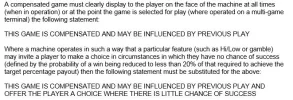
It could be a welcome complication though, as it makes it even harder for those involved to bury this issue, something they have been referring to as a minor matter of a wrong help file being distributed with the game. From the land based games, it seems the UKGC take a different view than most to the presentation of RTP data to the player, as well as being very clear when outcomes are not "natural" when given how the game displays itself. They already have rules covering the Hi/Lo gamble seen on many fruit machines, which use a number reel from 1-12 with the player having to pick whether the next number is going to be higher or lower. As the outcomes are not natural, but weighted depending on what the machine's current vs target RTP is at the time, this must be clearly stated on the front of the machine (not buried in some help file).

The UKGC may also be wary because they are about to be launched into the spotlight due to having to regulate the secondary licenses of large numbers of casinos that currently access the UK market via the whitelist scheme.
 
It could be a welcome complication though, as it makes it even harder for those involved to bury this issue, something they have been referring to as a minor matter of a wrong help file being distributed with the game. From the land based games, it seems the UKGC take a different view than most to the presentation of RTP data to the player, as well as being very clear when outcomes are not "natural" when given how the game displays itself. They already have rules covering the Hi/Lo gamble seen on many fruit machines, which use a number reel from 1-12 with the player having to pick whether the next number is going to be higher or lower. As the outcomes are not natural, but weighted depending on what the machine's current vs target RTP is at the time, this must be clearly stated on the front of the machine (not buried in some help file).

The UKGC may also be wary because they are about to be launched into the spotlight due to having to regulate the secondary licenses of large numbers of casinos that currently access the UK market via the whitelist scheme.

Yes the timing of this Playtech issue (and the Finsoft one) is for UKGC either awkward or helpful - they did refuse to do anything about BetFred who are not licenced by them for remote gambling but FinSoft have a UKGC licence. (A licence which they are still breaking the rules on at their website by not linking to the gambling commission, giving their licence details and listing which products are UKGC compliant).

Jenny Williams (UKGC Chief Exec) got a bit of a beating up at the DCMS select committee hearing - one of the members is seen as very pro industry and attacked her for Empire building for wanting to employ all of 12 people to cover the new remote licences! He seems to think Gib are fine and dandy for regulating UK consumer issues with UK listed companies.

Anyway she was pressed for details on how the GRA work in practice....it may be that she is welcoming getting a bit of hands on case work with the GRA...especially if it makes the GRA look bad and thus helps make the case for UK regulation.

Here is the relevant bit

You do not have permission to view link Log in or register now.


Q163 Philip Davies: Take, for example, companies that are regulated in Gibraltar, which is on the White List. Are you unhappy with the regulatory regime in, just for argument’s sake, Gibraltar?

Jenny Williams: We are not unhappy about it, but we do not know a great deal about it in detail and that is one of the problems. As life moves on there are the risks that emerge. It is not a very transparent regime in terms of getting information. That is not a criticism. It works perfectly well in-

Philip Davies: What is it that you do not know that you would like to know about the regulatory regime in Gibraltar?

Jenny Williams: How it works in practice. When you regulate companies like that you look at their systems, you look at their culture and you look at the way in which they deal with particular incidents. That gives you a sense as to whether they are behaving in a socially responsible way. I have no reason to suppose that the big companies that Gibraltar regulates are not, but I do not know and I do not have the information; so I cannot provide any assurance to the Department or to the Government or Parliament about approximately 80% of the market that has been regulated outside Great Britain.

Q164 Philip Davies: How did Gibraltar get on a White List if you cannot vouch for its regulatory regime? How did it get on a White List in the first place? The reason that it was on the White List was because we could vouch for its regulatory regime.

Jenny Williams: Can I make two points there? It is not on the White List. It is counted as part of Europe. That is just a question of fact. At the time that the 2005 Act was coming in, there was already a well-established market in Gibraltar, Alderney and the Isle of Man. The Government took the view they had broadly the same regulations and approach as we did. There was no reason to suppose there was a particular problem and no reason to disrupt matters. The point is that things are changing. At that stage very few other jurisdictions in Europe allowed online gambling. Although the system had its clunkiness and difficulties, it was perfectly tenable at that stage, but things move on and if I could take a particular example.

The Committee has probably seen a great deal about social gambling. That is where people do not win money prizes but they can either play for free or pay for gambling. We are looking at that at the moment because we have some concerns about whether that is being socially responsible and about whether in fact some of it is not gambling. Now, if we bring in conditions on our licensees about social gambling activities that might only affect 20% of the people operating in Great Britain. We would have to get all the other countries in the European area to change their regulations as well. Some of it would need primary legislation. That is not a very effective system of providing assurance to the Government.

Q165 Philip Davies: There are meetings of EU gambling regulators on a regular basis. Do you raise your concerns about their licensing regimes at those meetings? You did not even bring Gibraltar to the meetings that you had recently about this. Where have you set out in detail the Gambling Commission’s concerns about other regulators’ regimes? Where are they in the minutes of meetings and things like that where you have expressed clearly what your concerns are?

Jenny Williams: Those meetings are about, as it were, the mechanics of regulation and sharing best practice. We do indeed do our best in those meetings to find out about what other people are doing and we do our best in various other forums, like the International Regulators Gambling Working Party that I chair and the European one that one of my staff co-chairs, to find out and to express views and to share good practice. As I say, that is very different from the day-to-day contact and, indeed, the Gibraltar regulator himself would say that there is no substitute for the actual contact with the operators and understanding their systems.

The GRA Commissioner Phillip Brear had earlier given the committee written evidence, available here, where he defended his own empire in this regulatory turf war with a few digs at the UKGC....and UK consumers:

You do not have permission to view link Log in or register now.


42. There is widespread consensus amongst European jurisdictions with regard to technical standards and software testing. There is no evidence that British consumers are met with varying standards of any significance when they gamble remotely with the current range of preferred suppliers.

43. In some significant areas of consumer protection, current British standards are lower than those in Gibraltar and other jurisdictions. This includes licensing criteria, age verification and anti-money laundering requirements. The Gibraltar gambling Act has parallel objectives to the UK and is predicated on maintaining the good reputation of the jurisdiction.

44. It is wholly inappropriate for the DCMS paper to cite compliance by other regulators with UK equivalent data protection laws as a weakness or criticism. I can find no examples of any lawful information requests by the Commission being denied. An unlawful request was denied. Historically, it has been difficult to obtain information from the Commission, taking up to 10 weeks and multiple requests to secure the release of data known to be in its possession. This compares to a 24-72 hour service provided to them.

45. In terms of enforcement, the Gambling Commission has a record of pursuing very long term criminal investigations with little prospect of success, due to weaknesses in their analysis of ‘suspicious’ betting and sports incidents.

46. My office is copied in on all suspicious betting reports provided by Gibraltar licensees to the Gambling Commission. Very few of these result in visible interventions by any party in the UK. The impression is that there is insufficient capacity within the Commission to deal with all of the reports, with the vast majority being ‘filed’ or referred to sports bodies for their information and attention.

47. With regard to LCCP Condition 15, ‘suspicious’ is a very imprecise construct and the Commission could be overwhelmed. The new proposals will not bind all operators with the obligation to report suspicious bets. A new and unregulated market will thrive under the new proposals and ignore this requirement.

48. Outside UK horse racing, the major suspicious betting cases have not involved mainstream or licensed bookmakers, but betting facilities in countries much further afield, countries which will, for the first time, host companies who will be able to obtain UK operating licences, even if they do not hold a local licence, or there is no local licensing regime, as currently occurs under Commission policy.

49. The issue of confused customers has been grossly overstated. Where confusion arises it is often because the brand is a UK ‘High Street’ name, or simply because the language used is English and the customer has failed to read or react (click) to the information on the webpage indicating the relevant regulatory body. Additionally, it is universally the view amongst regulators that the large majority of complainants are remorseful losers seeking to recover losses, or customers who have knowingly breached terms and conditions in their efforts to obtain free bets and other bonuses. When these bets win, the win is declined as the customer has ‘cheated’. The customer then complains.

50. It is also disingenuous for DCMS to use other regulators’ complaints processes as a reason for change. The Gambling Commission does not investigate consumer complaints, it refers them all back to operators or industry funded arbitration services. In contrast, other regulators record and investigate all consumer complaints that operators do not remedy. This service will be taken away from UK consumers.

From the tone of these exchanges you can only imagine how well they will be cooperating on this issue. On the plus side it is important for both to be able to claim a win so maybe the current spat over needing a UK licence as well as a GRA one will lead to genuinely better consumer protection and even some sanctions and or industry guidance over these cases.

At least we might get a regulator who does not see complainants as cheats or con artists (oh yeah and stoopid for thinking that a UK high Street bookies with a UK licence and a UK stock listing might be UK regulated when the person in the UK bets online with them.....)...
 
The problem with that kind of stuff is more often than not, it takes a long time and then everyone forgets and they never release the statement. Remember when Rival was sending you letters from their lawyer asking you to delete threads? They were supposed to make a statement later as well, but never did. You locked the thread and everyone forgot.

Hopefully they won't do that with this story because I, for one, will not forget.
Big difference between Rival and Betfred/GRA/UKGC. :D
 
They already have rules covering the Hi/Lo gamble seen on many fruit machines, which use a number reel from 1-12 with the player having to pick whether the next number is going to be higher or lower. As the outcomes are not natural, but weighted depending on what the machine's current vs target RTP is at the time, this must be clearly stated on the front of the machine (not buried in some help file).

Specifically:

'THIS MACHINE MAY OFFER THE PLAYER A CHOICE WHERE THERE IS LITTLE CHANCE OF SUCCESS'

And yes, it has to be in full display on the front of every single compensated machine in the UK, and more recently, the new multi-game video terminals as well, on a game-by-game basis.

It'll be interesting to see if the UKGC are going down that route with 'compensated' online games, which the Finsoft card game clearly was. (Well, compensated, adaptive, cheating, take your pick.....)

message.webp
 
At the time that the 2005 Act was coming in, there was already a well-established market in Gibraltar, Alderney and the Isle of Man. The Government took the view they had broadly the same regulations and approach as we did. There was no reason to suppose there was a particular problem and no reason to disrupt matters.

I found it very interesting to read how Gibraltar got onto the "UK White List" in the first place. The got on because they were hosting a relatively large number of companies, and it was simply assumed that they were doing things right. In essence, they were taken at their word. Amazing.

As for the UKGC complicating matters by being involved on Finsoft....I'm inclined to say good, Finsoft have a UKGC licence whereas the GRA does not licence software providers.

Thanks again

I did not realize that the GRA does not license software providers. Again, amazing.

If you look to the west and see a dark and angry sky, with a steady breeze in your face, is it speculation to say that a storm is coming, or is it simply a logical conclusion based on experience and available data? That is, do you or don't you take your umbrella with you as you leave the house?

Chris
 
I found it very interesting to read how Gibraltar got onto the "UK White List" in the first place. The got on because they were hosting a relatively large number of companies, and it was simply assumed that they were doing things right. In essence, they were taken at their word. Amazing.

To be pedantic Gibraltar got in because they are in the EU (I share their MEP bizarrely), Alderney and the Isle of Man were white listed in.

At the time the UK had no track record for online regulation and Gib in particular was taking a very similar approach to the UK, they essentially copied it and got on with it quicker. The Gib 2005 Act took effect ahead of the UK 2005 Act that only kicked in for 2007.

I shouldn't smile but I would love to be a fly on the wall the next time these two meet up at some conference.

Whatever comes out in public over this issue eventually - with both involved, territorial hackles already up and stirred by the DCMS committee beating up Jenny and (slightly) by a certain Richas emailing his thoughts to the DCMS committee (and Jenny) I am expecting feathers to fly.

I am also expecting a bit of hissing and spitting within the DCMS committee on the whole GRA UKGC thing when they meet to draw up their report on the new legislation. They were rude enough on camera!
 
Update

Hi all,

Playtech released a patch for the fun/offline versions of the games mentioned in this thread some weeks back. We have since tested the games in a hidden live environment to ensure they respond as per the real-play versions. Betfred are now happy to release these games back on to the site, which will happen in the next few days.

We have also had assurances from Playtech that a full audit of games has been conducted, and not limited to the games built in a manner similar to Oceans Princess and Ugga Bugga, and Playtech can find no other issues. Our analysis verifies this.

To answer a specific question in the thread, the T-RTP of Oceans Princess is 99.07% - the same as advertised with other operators – and is now consistent in fun/offline and real-money play at Betfred (and I assume with all other Playtech operators) since the Playtech fix. Again, we apologise for any inconvenience caused by this and would like to reiterate there was no intent to mislead players.

Some people have brought up the other thread regarding SPIELOG2 and Betfred. As a quick update, the investigation by the GRA continues, and until then Betfred cannot provide any further information. Apologies for the delay on that one.

Thanks to all involved.

Aaron
 
To answer a specific question in the thread, the T-RTP of Oceans Princess is 99.07%

Just to clarify this Aaron - I assume that the T-RTP of Ocean Princess is 99.07% when employing optimal strategy? The Playtech documentation I've seen lists this game as between 97-99.07%, so I'd guess that's what you're saying.
 
Hi The POGG,

Yes, that's playing optimum strategy and is the maximum RTP for the game.

Cheers,

Aaron

I'm probably being a bit thick and missing something obvious, but how can a player play these games to optimal strategy when the actual reel strips are not provided?

This suite of games was designed in 2006 specifically to draw in video poker players, and standard Video Poker games such as 'Jacks or Better' or 'All American' are played with a known standard 52 card deck. Hence optimal strategy is knowable for these games, and can be found easily on gambling websites and in books.
I can't for the life of me work out how a player can ascertain optimal strategy on Ocean Princess or Ugga Bugga !?
 
To answer a specific question in the thread, the T-RTP of Oceans Princess is 99.07% - the same as advertised with other operators – and is now consistent in fun/offline and real-money play at Betfred (and I assume with all other Playtech operators) since the Playtech fix. Again, we apologise for any inconvenience caused by this and would like to reiterate there was no intent to mislead players.

Thanks for this Aaron.

There are a couple of outstanding questions on this Playtech issue though.

Was the t-RTP altered by the upgrade to the real game which was missed from the play version?

Was the optimal strategy for the game altered by the upgrade which was missed from the play version?

I am glad that they are back in line and that we have a known t-RTP but there is a big issue here about how a failure to update a play version can lead to a mismatch of t-RTP and alter game play.

If the t-RTP or optimal play was altered at any point in this saga - which it appears it was as otherwise there would be no mismatch - why was the software not recertified?

Thanks again.
 
I'm probably being a bit thick and missing something obvious, but how can a player play these games to optimal strategy when the actual reel strips are not provided?

This suite of games was designed in 2006 specifically to draw in video poker players, and standard Video Poker games such as 'Jacks or Better' or 'All American' are played with a known standard 52 card deck. Hence optimal strategy is knowable for these games, and can be found easily on gambling websites and in books.
I can't for the life of me work out how a player can ascertain optimal strategy on Ocean Princess or Ugga Bugga !?

Part of the learning curve is to get to know the reelstrips if you feel this is a necessary part of learning the optimal strategy.

In the early days of fruit machines (I am talking late 1970's), Barcrest produced a game "Line Up" where knowing the reel strips gave the player an advantage. It was in knowing whether to gamble for more nudges or accept what you had. If from knowing the reels you knew the jackpot was there, you didn't gamble for more nudges, as you could in fact lose. In those days, machines didn't feed everything to the player on a plate. Now, they show the win you have available with your nudges, so you don't have to figure things out for yourself.

Perfect strategy can exist for certain types of slot that offer holds and nudges during play, which is very much how video poker works. If the unheld reel is random, one can calculate a perfect holding strategy to get the best RTP. You don't need the actual reel strip, but you do need to know the probabilities of certain symbols dropping in, which is derived from the total number of each symbol on the reel.

During play, results can be recorded, and this will allow a reelstrip dataset to be constructed. In the 1970's players went round with little scraps of paper, playing "Line Up" and building up a picture of the reelstrips. Eventually, this could be learned by heart, which avoided getting spotted by arcade staff repeatedly consulting a piece of card during play (likely to get one kicked out). I still have the "Line Up" reelstrip cards, but the machine is long gone, just a few in the hands of collectors and "vintage" arcades survive.
 
And preserved for posterity by emulation!

And yes, that is a £2 jackpot :D

Old Attachment (Invalid)

That 10p was so annoying. You could not nudge through a win, so anything the wrong side of the 10p was unreachable even if there were enough nudges. It tended to block the Grapes, 10p instead of £1.50:mad:

What about the £3 version, and the reprogrammed £4 version (which I didn't like so much because of the changes).

Don't worry about emulating JPM Lootshoot, I have a real one downstairs:p
 
I'm probably being a bit thick and missing something obvious, but how can a player play these games to optimal strategy when the actual reel strips are not provided?

This suite of games was designed in 2006 specifically to draw in video poker players, and standard Video Poker games such as 'Jacks or Better' or 'All American' are played with a known standard 52 card deck. Hence optimal strategy is knowable for these games, and can be found easily on gambling websites and in books.
I can't for the life of me work out how a player can ascertain optimal strategy on Ocean Princess or Ugga Bugga !?

Optimal Strategy is pretty simple.

If you don't have a pair or a wild, what is the minimum value to hold for a single reel?

If you have a wild, what is the minimum value to hold for a pair?

If you have a pair, you hold the pair reels.

If you have three of a kind, you hold all three reels.

To determine optimal strategy, you would have to answer the first two questions.

1. Get the reel strips.

2. Run and record tens of thousands (hundreds of thousands?) of spins.

Chris
 
Hi all,

Thanks Vinyl and others for explaining optimum strategy in these games.

Ref the other questions directly asked by Richas:

The T/RTP of the real game was not altered by the fix; both are now running on the same model/RTP as real play was before.

Optimal strategy remains as is in real - no changes were made to the real play version.

Ref the mismatch: clearly this was totally unacceptable, and the rate at which Playtech made the change and we brought down the game reflects this. A flaw in the process of maintaining the free play version of these games by Playtech caused the problem, whereby free play model was isolated from the game servers - the RNG and mathematics existed inside the game application itself, and did not have to communicate with the game servers (like they do in real to record bets etc). As such, when patches were released to real the fun play version didn't get them. Over time, and these games are old, the disparity grew until the two did not match. We have subsequently asked Playtech to review all their games effected by a similar setup and I've had assurance no other cases exist.

Ref the last point: only the real version had to be certified when these games were released, and passed in real.

Hope this helps clarify things for you?

All the best,

Aaron
 
Hi all,
Ref the other questions directly asked by Richas:

The T/RTP of the real game was not altered by the fix; both are now running on the same model/RTP as real play was before.

Optimal strategy remains as is in real - no changes were made to the real play version.

Ref the mismatch: clearly this was totally unacceptable, and the rate at which Playtech made the change and we brought down the game reflects this. A flaw in the process of maintaining the free play version of these games by Playtech caused the problem, whereby free play model was isolated from the game servers - the RNG and mathematics existed inside the game application itself, and did not have to communicate with the game servers (like they do in real to record bets etc). As such, when patches were released to real the fun play version didn't get them. Over time, and these games are old, the disparity grew until the two did not match. We have subsequently asked Playtech to review all their games effected by a similar setup and I've had assurance no other cases exist.

Ref the last point: only the real version had to be certified when these games were released, and passed in real.

Hope this helps clarify things for you?

All the best,

Aaron

Thanks for this Aaron. It is very interesting that only the real version is certified. This seems odd when there is a requirement for both to be the same.

Your answer is detailed and specific which I am grateful for and welcome but it is so specific that it does not quite answer my question. I understand that this fix to the play games did not alter the t-RTP or optimal play of the real game. It couldn't really as it only changed the play game to bring it into line with the real.

My question is about earlier changes to the real game that introduced the difference - you have explained that changes to the real game were not applied to the play money version and so an unacceptable difference arose....this can only have happened if there were unannounced earlier changes to the real game that did alter the t-RTP and/or the optimal strategy.

Am I correct that since the play game stopped being updated changes were made to the t-RTP of the real game and/or that changes to the optimal strategy of the real game were made. Logically this must be the case. If so when and how often were these changes made?

Also when did the difference between the play and real versions first happen?

Once again thankyou for your responses and thankyou for making sure that the play version now matches and that all Playtech games have been audited to confirm that play and real games match.
 
Last edited:
Hi Richas,

You hit on the one question still outstanding from Playtech, i.e. when the changes were made to the real version to cause the deviation between real and fun. From the answers I have back to date, it's been insinuated that the key changes (changes that would cause an RTP change) happened early on during the game's development. I'm waiting for absolute confirmation, but this is the only acceptable answer from Playtech. Will keep you informed.

Thanks,

Aaron
 
Thanks again Aaron.

Should we anticipate a statement either from Playtech or from the GRA?

Also are you expecting any regulatory action to be taken against BetFred by the GRA over this as a result of your supplier's error? Playtech after all don't hold a GRA licence so they can't really act against them.

Richas
 
Hi Richas,

Would be from Playtech but via me.

Reference GRA action; this depends entirely on the GRA. They are aware of this thread and we have discussed the issue at length. They would have to consider that the issue was not unique to Betfred too, which may delay their response, if they indeed make one - they may consider the matter resolved given the actions taken. Indeed, it may prompt a wider look at responsibility, but we'll see.

Cheers,

Aaron
 
Hi all,

This is the Playtech response I just received:

'Back then (2004 and earlier), it was very usual that the reel sets of games were modified several times before the game actually went live – to fine tune the probabilities...'

As suspected, the deviation occurred prior to the game being released, and therefore the performance of real play is as advertised from the game's launch.

Regards,

Aaron
 

Users who are viewing this thread

Accredited Casinos

Read about our rating system and how it's done.
Back
Top