AFAIK, TRTP is not a number that can be calculated at any particular moment like RTP is i.e. the slot TRTP is 97% (or whatever) and it is no less or more at any given point. Whether the slot is able to pay more at a given point in time than another does not affect it's overall TRTP. The "theoretical" part means that, over the long term, the slot SHOULD (and mathematically does in practice) pay extremely close to that number.
RTP can be calculated at any point, whereas TRTP can not. It's really not much different than hitting free spins on any slot where there is a range of spins and multipliers....you hit the lowest number on the lowest multiplier, and your potential for a big hit is lower, but the TRTP has not changed. It does not increase when you hit the highest spins on the highest multiplier. Am I making sense?
Since a true video slot is a finite machine (i.e. it has a finite number of reels with a finite number of reel stops) TRTP can be combinatorially calculated at any given moment once you know the exact finite probability of events and the corresponding paytable. This calculation might be very complex for slot machines with long reel strips, hence it is often replaced by simulation of million spins. This simulation estimates the combinatorial theoretical probability and TRTP which is hard to calculate. But for accumulator type games, this simulation has a high difference to the combinatorial TRTP if the sample is from the very first beginning of the game on that slot.
Let me give some simplified examples. The estimated TRTP for both slots will be the same on the long run.
Slot A. For each spin, you have the following possible outcomes betting a single coin:
Empty spin, 90% of the time, pays zero.
Win of 5 coins, 9% of the time, pays 5 coins.
Feature, 1% of time, pays 50 coins (let's have this as a static 50 coin win, it does not matter now).
Now the combinatorial TRTP is the following if you bet a single coin:
0.9*0 + 0.09*5 + 0.01*50 = 0.95.
If you would run a simulation for this game for TRTP, it would also reach 95% (0.95), and at any given point of game play, the TRTP is 95%.
Slot B. For this slot, you need to get a given combination 5 times to get the feature.
For each spin, you have the following possible outcomes betting a single coin:
Empty spin, 85% of the time, pays zero.
Win of 5 coins, 9% of the time, pays 5 coins.
Feature accumulator, 5% of time, when the fifth is collected, feature pays 50 coins (let's have this as a static 50 coin win, it does not matter now).
The simulated RTP of this slot would also be 95% over a big sample (you need to hit a 5% probability event 5 times more than you need to hit a 1% event probability for slot A).
However assuming your accumulator is on zero, your combinatorial TRTP will be lower than 95% for that spin, since you have:
0.85*0 + 0.09*5+0.5*0 = 0,45, which is 45%. For that single spin you have 0% to hit the feature, since you need to collect five somethings to trigger. Hence the feature payout is impossible to achieve on the next spin on slot B, while it is possible to achieve on slot A.
With other words, if you only play a single spin in your lifetime on slot A, your TRTP is 95%, but if you only play a single spin on slot B, your TRTP is 45%.
The reason that the above things and the identical TRTP can co-exist is that for accumulator games, once you have accumulated 4 out of 5 on slot B, your TRTP for the next spin will be the following:
0.85*0+0.09*5+0.05*50 = 2.95 = 295%.
But you needed to play a few spins with a lower "per spin" TRTP to get there.
Now connecting back to the original topic. I always had the assumption that features like in Thunderstruck2 are equally powerful, not matter you need to unlock some of them. If it is not the case for the game in this thread, than the above considerations would apply to this game.
Edit: considering Igor's post in the meanwhile, if he is stating that the features in this game are equally powerful, than my above comments does not apply to this game.












 . Seriously?

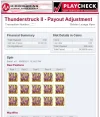


 Yikes, I would have never thought about those multiplier spins, but they are effectively doubling the amount of spins player has.