external image

Question Your help on these observations....

Therefore I am not entirely convinced of MG game fairness yet and I feel like measuring the distances between high payouts that we discussed yesterday, might be a good idea.

I am not sure I agree here. How would you test the fairness of a 6 sided pair of dice? You would do exactly what you have done - shown that the pearson chi square test of observed versus expected values is not significant. That would show there is no statistical evidence to support that the outcomes are anything other than random. Now that you have shown that in your analysis I do not quite see how you can doubt the fairness. Essentially your data set is a single sample (very large one admittedly) but the pattern could have quite easily be reversed with all of the big losses happening at the start of the run which get made up with a few massive wins later on in the play. It is only a matter of pure coincidence that the end of the data sample occurs at the point that the observed RTP has regressed back to the TRTP. If you split your data into 2 equal sets split at the median date-time then you would have seen 2 very different observed RTP values but I would not be surprised at all if the statistical analysis of each independently would still return a non-significant p-value. In fact it might be interesting to reverse apply the analysis and obtain the observed RTP value that would be required to return a significant p-value to indicate a non-fair game.

As for testing the distances between the big win payouts, that would be interesting, but it would require similarly massive samples. Furthermore, with such small probabilities involved, longer than average gaps would be quite likely to occur. Considered as a Bernoulli trial with known success probability we could obtain theoretical variance based on a fixed number of spins, but I am not sure what could be done with that as the distribution is not remotely gaussian and so we cannot apply the things like 95% confidence intervals based on 2 standard deviations either side of the mean as we can with normal distributions. The distributions for such small probabilities are massively skewed.

Unfortunately it is many years since I finished me phd and I have not used this stuff for years and no longer work as a mathematician anymore so I am rusty. I might go and dig around in my old course text books to see what kind of analysis would be appropriate for such data but to be honest I really do feel that your results do confirm the games fairness
 
I am not sure I agree here. How would you test the fairness of a 6 sided pair of dice? You would do exactly what you have done - shown that the pearson chi square test of observed versus expected values is not significant. That would show there is no statistical evidence to support that the outcomes are anything other than random. Now that you have shown that in your analysis I do not quite see how you can doubt the fairness. Essentially your data set is a single sample (very large one admittedly) but the pattern could have quite easily be reversed with all of the big losses happening at the start of the run which get made up with a few massive wins later on in the play. It is only a matter of pure coincidence that the end of the data sample occurs at the point that the observed RTP has regressed back to the TRTP. If you split your data into 2 equal sets split at the median date-time then you would have seen 2 very different observed RTP values but I would not be surprised at all if the statistical analysis of each independently would still return a non-significant p-value. In fact it might be interesting to reverse apply the analysis and obtain the observed RTP value that would be required to return a significant p-value to indicate a non-fair game.

I see what you mean and I don't necessarily disagree.

But let me try to explain my point one more time in terms of dice since you happened to mention testing dice for fairness.

Suppose that a player is offered a game where he can guess the value of a single 6-sided die. There are two versions of this game available. Our suspicious player tests both of them by playing 10000 rounds on both games and recording what the face value of the die was each time. The frequencies of observed faces in the first game are:

1: 1662
2: 1656
3: 1659
4: 1641
5: 1707
6: 1675
TOTAL: 10000

and in the second game:

1: 1667
2: 1667
3: 1667
4: 1667
5: 1666
6: 1666
TOTAL: 10000

Chi-square test p-value for the frequencies in the first game is 0.96 and for the second game 0.999999.... Both values are close to 1 so do we conclude that they are both completely random?

In fact: The first game works by drawing a random number between 1 and 6 and assigning that value as the value of the die. The second game works by checking what the value of the die was last round and adding +1 to it's value in the next round. If the value in the last round was 6 then the value in the next round is 1.

So in fact the latter game is completely non-random, in fact it is completely deterministic. But it passed the chi-square test for fairness.

Furthermore, suppose now that these games are offered online and a winning guess pays 5.9x bet so there is a built-in house edge of 1.67% (true odds would pay 6x). The player has to choose one number and stick to it in every round. In game #1 player's results are subject to randomness and luck. If he happened to choose lucky number #5 he would actually still be 71.3 units ahead after 10000 rounds played (1707*5.9 - 10000 = 71.3) despite 1.7% house edge.

But in the second game no matter which number the player chooses he will always be at 164.7 units loss after 10000 rounds played. In fact because of the deterministic nature of the game the player will always end up precisely at TRTP.

So here you have two games, both of which would pass your criterias for fairness and randomness and in fact in one of them the player can never actually win. So I hope this example clarifies to you that there is more to game fairness testing than meeting the RTP. The problem is that it's not too hard to design a game where the player will ultimately meet the TRTP in such a way that he really never stood a chance of winning. On the other hand the player's goal is actually to not to meet the TRTP but to deviate as much as possible from it in the positive direction for as long as possible, and it's possible to quantify how often this should occur.
 
5. Has anyone noticed (like I did the other night on 188bet) that on MG flash games on some sites, like TSII you can tell if the spin will produce a win by the slightly longer spin of the first reel before it stops. I definitely saw this, NOT a foil-hat thing btw! I could tell for example that even though the first 2 reels were non-matching, that I would get a couple of scatters on the last 3 reels by the delay.....basically I pressed spin and knew before any reel had stopped whether it would be a winner or not. Awful experience.

I cant answer the first 4, but i can help with no. 5.

It's to do with the infrastructure of QF vs Viper.

Normal 1 spin functions as a call/chat between MGS servers and the servers of the site you are playing on that handles your balance and transactions. It goes a little like this:

You hit spin and...

MGS: Hey <insert operator API>, what's the balance for this player?
Operator: It's X.
MGS: Cool, he wants to place a <instert bet amount> bet, can i allow?
Operator: Sure, go ahead.

... the spin begins. Now, if it's a dead spin. The conversation will finish like so:

MGS: Bust. close round bro.
Operator: No problem.

... if however the spin is a win, then the conversation is:

MGS: Vicotry fella! Award the <inster win here>.
Operator: nice, awarded.
MGS: Close round please.
operator: Sure thing.

**********************

Each one of these lines is an API call that takes fractions of a second. On Viper systems, MGS talks to itself because they both handle transactions, balances and game results. With QF, only game results are in MGS control, so the conversation depends on the processing speed of the operator itself. Meaning, if MGS doesn't receive an answer to their AWARD line the animation has to compensate a little bit.

Remember that we are talking about fractions of a second here. In most cases for optimised providers, the entire conversation happens in under 100ms (10th of a second)

Sometimes when the system is loaded on the operator side they may take time to reply to all those questions delaying the spin duration (what you experience as spin lag) and sometimes they just time out (what you see as widespread error2).

Often though, it's just a tiny delay that's symptomatic to what you described above.
 
haha....you are asking the man who banned users for "colluding" playing slots ;-)....but lets not get into that in this thread!
 
Suppose that a player is offered a game where he can guess the value of a single 6-sided die. There are two versions of this game available. Our suspicious player tests both of them by playing 10000 rounds on both games and recording what the face value of the die was each time. The frequencies of observed faces in the first game are:

1: 1662
2: 1656
3: 1659
4: 1641
5: 1707
6: 1675
TOTAL: 10000

and in the second game:

1: 1667
2: 1667
3: 1667
4: 1667
5: 1666
6: 1666
TOTAL: 10000

Chi-square test p-value for the frequencies in the first game is 0.96 and for the second game 0.999999.... Both values are close to 1 so do we conclude that they are both completely random?

In fact: The first game works by drawing a random number between 1 and 6 and assigning that value as the value of the die. The second game works by checking what the value of the die was last round and adding +1 to it's value in the next round. If the value in the last round was 6 then the value in the next round is 1.

So in fact the latter game is completely non-random, in fact it is completely deterministic. But it passed the chi-square test for fairness.

Furthermore, suppose now that these games are offered online and a winning guess pays 5.9x bet so there is a built-in house edge of 1.67% (true odds would pay 6x). The player has to choose one number and stick to it in every round. In game #1 player's results are subject to randomness and luck. If he happened to choose lucky number #5 he would actually still be 71.3 units ahead after 10000 rounds played (1707*5.9 - 10000 = 71.3) despite 1.7% house edge.

But in the second game no matter which number the player chooses he will always be at 164.7 units loss after 10000 rounds played. In fact because of the deterministic nature of the game the player will always end up precisely at TRTP.

But this is precisely the nature of RNG algorithms as far as I am aware. I am not an expert in this field at all, but anything that is generated via an algorithm is deterministic to a certain extent. All we can do is to perform statistical tests on the output of such an algorithm to ascertain if it is actually producing the right amount of each number based on the underlying distribution.

Also, your example illustrates why this is not good for a casino - if it was obviously deterministic, then it could be exploited by a savvy player to the ruin of the casino.


So here you have two games, both of which would pass your criterias for fairness and randomness and in fact in one of them the player can never actually win. So I hope this example clarifies to you that there is more to game fairness testing than meeting the RTP. The problem is that it's not too hard to design a game where the player will ultimately meet the TRTP in such a way that he really never stood a chance of winning. On the other hand the player's goal is actually to not to meet the TRTP but to deviate as much as possible from it in the positive direction for as long as possible, and it's possible to quantify how often this should occur.

I see what you are saying here, but I have my own theory here which I think is almost obvious and that is that the sampling distribution of players RTP over a given fixed sample size would be normally distributed with mean value of the true RTP of the slot. If we took say 10,000 samples each of 10,000 random spins (I know thats a lot of spins in total), calculated the observed RTP of each and tested the resulting distribution for normality, then I would be willing to bet next years salary that it would be very close to a normal distribution. This should be the case via the central limit theorem. In that case we would see as many players above TRTP as we would below TRTP, so with your above example we would also have players that could never lose. This would be simple enough to verify using kktmd's automated reel spin data in free play mode.
 
Igor, are the slots rigged to protect the casinos so someone cannot win "too much"?

No not at all Balth. What these quazi mathematicians forget in their infinite wisdom is that we have no data on exactly pay-line probabilities (we have close-as assumptions).

Between jufo and kkt there was already a discrepancy of 1000x bet probabilities on volatile games, whereas when jufo ran 10million simulations he arrived a 160K spins, whereas kkt was assuming an average of 300K spins. Those a widely different results from two statisticians trying to achieve the same outcome. hmmm?

Jufo was right btw on that one.

Then there is the data sample:

While you work of real money data 300,000 spins heavy - what about 3M (which is tiny, even for a small operator) Or 3 billion spins - which is probably close to the average spin count on a particular slot when being tested before market deployment and annually by testing laboratories.

Keep in mind that the third party testing labs at that point would have actual source code while testing the RTP, volatility score and outcome - their main job is ensuring no "cycle" can be deduced across enormous amount of spins, while as a result trying to to hack the machine.

3rd party test slots on on its randomness score for a very good reason: Pure randomness is there to protect both slot provider and the player. Which is what these quasi-mathematicians always fail to bring up since it would put a chink in their conspiracy-armour.

While a games provider has 5% edge, the provider NEEDS their slots to be random. All we need to do is wait for a enough players to show up and the numbers will pay out their own profit. These conspiratists here forget that if the casino designs a slot that is anything BUT random (aka has a cycle), it will design an outcome that can be calculated and if something can be calculated, then that something can be expected - in which case, these people as smart as they are, will find out how and take the casino for millions.

I mean, let's take Jufo's theory, and really listen to it. In essence, it says: "Yes, there is a chance that a LUCKY (isn't that why we all do this? - luck?) player can bust a casino, so Microgaming, the provider of 400 casinos of varying sizes and capacity answering to an absolute HOST of regulators, may very well have designed their games to perform in a NON-random manner to protect against that one LUCKY possibility in respect of one of their operators.

I mean, what a load of.... lol's!

Ok Jufo, let's for a split second agree that MGS will produce a non random set of machines, you still cant force a player to play for as long as you need them to unless you have them at a gunpoint. The slot performance will continue to depend across thousands of players spinning millions of spins.

I mean you brought Mr. Shackleford into our thread but now you are claiming possible non-randomness of slots? Hmmm, if Mike was to hear you lol.

So back on topic - non random machine creates a cycle, cycle CAN be deduced and as such a slot hacked. No point in doing that if already every spins has an inbuilt edge into its probability through payout value.

Frankly Jufo, with all your simulation capacity - what on earth are you doing here? Why not be running the stimulations until the cycle becomes clear and go win that chest of gold lol....


Fact is, if one bloke even does strike lucky (which is why casinos exist in the first place!!!) there is so much volume and so much spinning across the network - it's insignificant to the network itself.

Yearly audits, multiple regulation criteria, third party certifications... Dun I hope you have enough foil hats for the lot as above is worthy if an 'illuminati' membership. Though the mathematics were fun to follow - the assumptions derived are based on many ifs and buts... and not much actual logic.

haha....you are asking the man who banned users for "colluding" playing slots ;-)....but lets not get into that in this thread!

Actually jufo's own statistical analysis proved that playing on the same game while achieving same volume; 25% of bonus users will cash out on a bonus, that a single person wouldn't even come close to clearing. meaning same bonus cut in 10 parts will have 2.5 of those parts ckear it! After that I haven't seen him on the thread again of course, provably because his own simulation showed that :)

By JUFOS OWN EXAMPLE: giving 10x100 bonuses at x35 wioll have 25% of those clear and 75% of those bust. Making 25% of those group cash out "something", while giving 1x1000 bonus generating the same volume will not even come lose to the WR that one bonus would require.

So kktmd, while it may not change the nature of the game, as it shouldn't, IT does change the expected value that can be derived from the bonus.

Jufo, you didn't answer how much did each one of those 25% cash out on average. Would be interesting to know.

You boys play with your sandbox if conspiracy theories :) I just wanted to offer duns a 'factual' reason why sometimes the slow spin that isn't based on tin-foil maths ;)
 
Last edited:
I see what you are saying here, but I have my own theory here which I think is almost obvious and that is that the sampling distribution of players RTP over a given fixed sample size would be normally distributed with mean value of the true RTP of the slot. If we took say 10,000 samples each of 10,000 random spins (I know thats a lot of spins in total), calculated the observed RTP of each and tested the resulting distribution for normality, then I would be willing to bet next years salary that it would be very close to a normal distribution. This should be the case via the central limit theorem. In that case we would see as many players above TRTP as we would below TRTP, so with your above example we would also have players that could never lose. This would be simple enough to verify using kktmd's automated reel spin data in free play mode.

Interesting you brought that up because what you say above is exactly what I analysed together with a casino software manager (Chris Colby from Galewind) last year.

The whole thread is here. It is written by a casino software president so it's worth a read:
https://www.casinomeister.com/forums/threads/slot-statistics-critiques-requested.49985/

Please read especially these posts by me:

Distribution of RTPs across 10,000 players on a medium-variance slot after 2000 spins:
https://www.casinomeister.com/forums/threads/slot-statistics-critiques-requested.49985/

Distribution of RTPs across 10,000 players on a medium-variance slot after 10,000 spins:
https://www.casinomeister.com/forums/threads/slot-statistics-critiques-requested.49985/

In the latter I did exactly the test that you mentioned.

The results were that even across 10,000 spins the RTPs were not nearly normally distributed and the tail to the right (big wins) was still heavy. Normal distribution approximation systematically underestimated the chances of big wins which is why there were numberous values between +7 SD and +9 SD even though the odds for for a +7 SD result are very close to zero. The heavy tail to the right is compensated by shift of median to the left so it is always the case that the median RTP < TRTP.

So if you actually had slot results where the RTP is normally distributed after 10,000 spins then it would actually cheat some of the biggest winners from their big wins, ie. cut out the tail to the right.

I will send you my banking details now via PM so you can now send me your next year's salary as promised ;)
 
Last edited:
Fact is if one bloke even does strike lucky (which is why casinos exist in the first place!!!) there is so much volume and so much spinning across the network - it's insignificant to the network itself.

Yearly audits, multiple regulation criteria, third party certifications... Fun I hope you have enought foil hats for the lot as thus us worthy if an 'illuminati' membership. Though the Margaret were fun to follow - the assumptions derived are based on many ifs and buts...

Hmm but I remember you posting something to the effect that you once got hit for 400K and it almost shut down your operation if it wasn't for your financial backers. Of course you say now that you can handle even the biggest wins, because no one would play at your place if you didn't say that.

Actually jufo's own statistical analysis proved that playing on the same fame while achieving same volume; 25% of bonus users will cash out on a bonus, that a single person wouldn't even come close to clearing. meaning same bonys cuf in 10 parts will have 2.5 of those parts ckear it! After that I haven't seen him on the thread again of course, provably because his own simulation showed that :)

No, my maths are still right and a single bonus gives the same EV even if it is split into 10 parts. But upon seeing that it was impossible for you to understand the maths, I decided that it's not worth my time to explain it to you any longer. Also some APs contacted me and advised that it is a bad idea to try to educate the "enemy".
 
Interesting you brought that up because what you say above is exactly what I analysed together with a casino software manager (Chris Colby from Galewind) last year.

The whole thread is here:
https://www.casinomeister.com/forums/threads/slot-statistics-critiques-requested.49985/

Please read especially these posts by me:

Distribution of RTPs across 10,000 players on a medium-variance slot after 2000 spins:
https://www.casinomeister.com/forums/threads/slot-statistics-critiques-requested.49985/

Distribution of RTPs across 10,000 players on a medium-variance slot after 10,000 spins:
https://www.casinomeister.com/forums/threads/slot-statistics-critiques-requested.49985/

In the latter I did exactly the test that you mentioned.

The results were that even across 10,000 spins the RTPs were not nearly normally distributed and the tail to the right (big wins) was still heavy. Normal distribution approximation systematically underestimated the chances of big wins which is why there were numberous values between +7 SD and +9 SD even though the odds for for a +7 SD result are very close to zero. The heavy tail to the right is compensated by shift of median to the left so it is always the case that the median RTP < TRTP.

So if you actually had slot results where the RTP is normally distributed after 10,000 spins then it would actually cheat some of the biggest winners from their big wins, ie. cut out the tail to the right.

I will send you my banking details now via PM so you can now send me your next year's salary as promised ;)

When we talk about TRTP we aren't talking about 10,000 spins or even 500,000 spins. As Igor said, its really about multiple millions or perhaps billions.

I would expect fairly wide RTP ranges in 10,000 spins.

The data gathered by kktmd over millions of spins shows that the TRTPs are as advertised.

I'm just not seeing any "conspiracy fuel" here...or am I looking in the wrong place?
 
Hmm but I remember you posting something to the effect that you once got hit for 400K and it almost shut down your operation if it wasn't for your financial backers. Of course you say now that you can handle even the biggest wins, because no one would play at your place if you didn't say that.

What i am saying is that GAMES are not ours - they are MICRO-GAMINGS. and if we shut down they still have 399 operators to continue using their games.

You are mixing apples and oranges. What i said is that microgamign is not going make a game hackable because i may not have sufficient liquidity to support it. At best they drop the max bet size per game for us to limit exposure.

No, my maths are still right and a single bonus gives the same EV even if it is split into 10 parts. But upon seeing that it was impossible for you to understand the maths, I decided that it's not worth my time to explain it to you any longer. Also some APs contacted me and advised that it is a bad idea to try to educate the "enemy".

:lolup: AP's contacted you, telling you stop proving their "lack" of ability to beat the casino? Ok, that makes sense.

Your stats showed 25% of the bonus segments awarded clear, i just asked you by how much? When they do clear - how much is the average balance?

Fact of the matter is, in both cases you got 18,000 wagered. However only in the colluding case that 18,000 get's any amount cleared (25% of awarded bonuses), since in a single player case 35,000 is necessary to turn those funds real 18k doesn't even come close.

Frankly, as enjoyable this is to read - you keep trying to "crack" the non-randomness of slots. I'm sure it's a time well spent. 0

It's definitely fun to read a scenario where mathematics keep trying to defy logic.
 
When we talk about TRTP we aren't talking about 10,000 spins or even 500,000 spins. As Igor said, its really about multiple millions or perhaps billions.

I would expect fairly wide RTP ranges in 10,000 spins.

The data gathered by kktmd over millions of spins shows that the TRTPs are as advertised.

I'm just not seeing any "conspiracy fuel" here...or am I looking in the wrong place?

Yes, there is no conspiracy fuel. The person in this thread who is most after conspiracies is dunover, but at least for me this thread is simply to have a discussion on how to develop new statistical methods to verify game fairness. I think it's very likely that MG slots are entirely fair and until now they have passed all the tests I have made (such as for payouts distribution frequencies) but it's still good to have discussion about possible new statistical methods. So to me this is not supposed to be about conspiracies but about statistical tests. While you can argue about the usefulness of these tests it's always possible that they may reveal something, somewhere, someday.
 
Yes, there is no conspiracy fuel. The person in this thread who is most after conspiracies is dunover, but at least for me this thread is simply to have a discussion on how to develop new statistical methods to verify game fairness. I think it's very likely that MG slots are entirely fair and until now they have passed all the tests I have made (such as for payouts distribution frequencies) but it's still good to have discussion about possible new statistical methods. So to me this is not supposed to be about conspiracies but about statistical tests. While you can argue about the usefulness of these tests it's always possible that they may reveal something, somewhere, someday.

I actually really agree with above.


It's below that makes me giggle, When a result arriving at RTP is "almost too convenient" even though for the majority of his 300,000 spin cycle the player kept well above expected RTP%. What would have been not convenient?

Personally I love most of the posts you put forward, but below just seems to defy the logic of the mathematician within.

Yeah if you look at the graphs within the report I linked, the player is significantly above TRTP at first and then falls almost too conveniently close to it at the end. But he did hit each of payout magnitudes expected number of times so it is hard to complain with a result like that. It now becomes a question of how can one dig deeper beyond this and measuring the distances between large payouts was the first thing I could think of to separate a random slot from a fruit machine one. The problem is that even with those 200k spins of real money BDBA data there might not be enough big hits to get reliable analysis of their distances.
 
It's below that makes me giggle, When a result arriving at RTP is "almost too convenient" even though for the majority of his 300,000 spin cycle the player kept well above expected RTP%. What would have been not convenient?

Personally I love most of the posts you put forward, but below just seems to defy the logic of the mathematician within.

Suppose that you play roulette with no zero (for simplification) and you play 10000 rounds:

You get:

RED: 5001
BLACK: 4999

You play 10000 rounds again and get

RED: 4998
BLACK: 5002

The above results are actually highly unlikely to stem from a random and fair game because the results are too close to expectation. Therefore if you had the results like above you should be immediately very suspicious. Data that matches predictions too precisely is as problematic as data that doesn't match expectations, and it hints that the results are not stemming from a random stochastic process but rather a manifactured (non-random) one.

However, I agree that it is highly likely that the player whose data I analysed ended so close to TRTP by pure coincidence. I would need too see more data of similar magnitude (100K+ hands) to see if the pattern repeats.
 
Suppose that you play roulette with no zero (for simplification) and you play 10000 rounds:

You get:

RED: 5001
BLACK: 4999

You play 10000 rounds again and get

RED: 4998
BLAC: 5002

The above results are actually highly unlikely to stem from a random and fair game because the results are too close to expectation. Therefore if you had the results like above you should be immediately very suspicious. Data that matches predictions too precisely is as problematic as data that doesn't match expectations, and it hints that the results are not stemming from a random stochastic process but rather a manifactured (non-random) one.

Yes, however your data was not "too close" at all, was it? The guy asked you to check the data after losing enough money to make him doubt the casino. He didnt ask you to analyze anything when he was up, or for tha tmatter when he kept on "under-performing" in terms of this expected losses.

True doubt would have arrived when you assigned another 300,000 spins and then another 3000,000 spins and his p&L would have not spiked after reaching TRTP. Because, if the game is somehow "designed" - what then?

Does the game recognises one player from the other? Are you suggesting that the game "could have" recognised this player and changed payouts as to make it player centric?

If so, what do you think the next 600,000 spins would show? would the game stay precisely at the RTP% or would he be a"allowed" another spike? What happens after reaching TRTP? is the game code designed to deviate away from the RTP again and then bring it back home? What's the cycle?

Logically it makes no sense to me for any game to do this. Your roulette example above can be thrown out the window because such simplistic view would have been caught out aeons ago. I want to understand the reason why a provider should design a slot that "calculates" and changes outcome in order to achieve its RTP per player. Then i want to see how does the slot intend of keeping the player playing?

It just seems so... intangible.
 
Yes, however your data was not "too close" at all, was it? The guy asked you to check the data after losing enough money to make him doubt the casino. He didnt ask you to analyze anything when he was up, or for tha tmatter when he kept on "under-performing" in terms of this expected losses.

True doubt would have arrived when you assigned another 300,000 spins and then another 3000,000 spins and his p&L would have not spiked after reaching TRTP. Because, if the game is somehow "designed" - what then?

Does the game recognises one player from the other? Are you suggesting that the game "could have" recognised this player and changed payouts as to make it player centric?

If so, what do you think the next 600,000 spins would show? would the game stay precisely at the RTP% or would he be a"allowed" another spike? What happens after reaching TRTP? is the game code designed to deviate away from the RTP again and then bring it back home? What's the cycle?

First of all, if you read my report from analysing this player's results (at:
You do not have permission to view link Log in or register now.
) I did state in the report that the player's results seemed fair and were in line with expectations. So you have to remember that we are theoretising and speculating here.

Logically it makes no sense to me for any game to do this. Your roulette example above can be thrown out the window because such simplistic view would have been caught out aeons ago. I want to understand the reason why a provider should design a slot that "calculates" and changes outcome in order to achieve its RTP per player. Then i want to see how does the slot intend of keeping the player playing?

It just seems so... intangible.

I do see the benefit in reducing the number of players who manage to get ahead. Please refer to the graph in this post which was taken over 10,000 players who each had played 2,000 spins on the same slot. https://www.casinomeister.com/forums/threads/slot-statistics-critiques-requested.49985/

Now 36.51% of these players should be ahead after 2000 spins played, ie. they will be able to cashout a profit. If you can tune the slot a bit so that the fraction of players ahead is only 20% instead of 36.51% the casino would save quite a bit of money. Of course to compensate this they would have to increase the RTP of some of the worst losers to yield 95% RTP overall but I still see motivation to do this to mitigate the risks for the casino operator.
 
Interesting you brought that up because what you say above is exactly what I analysed together with a casino software manager (Chris Colby from Galewind) last year.

The whole thread is here. It is written by a casino software president so it's worth a read:
https://www.casinomeister.com/forums/threads/slot-statistics-critiques-requested.49985/

Please read especially these posts by me:

Distribution of RTPs across 10,000 players on a medium-variance slot after 2000 spins:
https://www.casinomeister.com/forums/threads/slot-statistics-critiques-requested.49985/

Distribution of RTPs across 10,000 players on a medium-variance slot after 10,000 spins:
https://www.casinomeister.com/forums/threads/slot-statistics-critiques-requested.49985/

In the latter I did exactly the test that you mentioned.

The results were that even across 10,000 spins the RTPs were not nearly normally distributed and the tail to the right (big wins) was still heavy. Normal distribution approximation systematically underestimated the chances of big wins which is why there were numberous values between +7 SD and +9 SD even though the odds for for a +7 SD result are very close to zero. The heavy tail to the right is compensated by shift of median to the left so it is always the case that the median RTP < TRTP.

So if you actually had slot results where the RTP is normally distributed after 10,000 spins then it would actually cheat some of the biggest winners from their big wins, ie. cut out the tail to the right.

I will send you my banking details now via PM so you can now send me your next year's salary as promised ;)

That is pretty interesting and illustrated some naive thinking regarding the sample size on my part. I plucked the 10,000 from nowhere but thinking about things the distribution would skewed over such a small sample size just because there is always the chance that you could win 10,000 x bet plus in a single spin where as the chances of losing 10,000 x bet (ie winning zero on EVERY spin) effectively zero. So the distribution of the RTP is always bounded below by 0% but theoretically unbounded above. I am going to have to think about that a lot more though as it is not immediately obvious to me why the central limit theorem would not hold here (other than the too small sample size).

Could this deviation from normality be down to the feature modes of the games? Considering things like bonus rounds, free spin retriggers etc. I don't suppose that you have a similar analysis of the same data just in the base mode of games?

I suppose perhaps I am making a mistake here of viewing the RTP as a true statistic as it is actually bound intrinsically to the prize payout for each event. Clearly there is some fundamental error in thinking on my part at work here. This is getting a little addictive now and I can see I am not going to be able to let this go....
 
Your stats showed 25% of the bonus segments awarded clear, i just asked you by how much? When they do clear - how much is the average balance?

Fact of the matter is, in both cases you got 18,000 wagered. However only in the colluding case that 18,000 get's any amount cleared (25% of awarded bonuses), since in a single player case 35,000 is necessary to turn those funds real 18k doesn't even come close.

Sigh,
ok then here are the results for the last time:

Numbers from playing a single $100 bonus through based on 10000 trials:
You do not have permission to view link Log in or register now.


Numbers from playing a single $1000 bonus through based on 10000 trials:
You do not have permission to view link Log in or register now.


Above shows that a single $1000 bonus broken down to ten $100 seaprate bonuses both have the same EV, so you are wrong.

If you want to double-verify the numbers here are the exact end results of each run separately in Excel file:
For $200 bankroll:
You do not have permission to view link Log in or register now.

For $2000 bankroll:
You do not have permission to view link Log in or register now.
 
Ok, so let's theorise that MGS has casino benefits at heart and 5% flat commissions across billions in volume isn't enough. Let's theorise that they would risk the overwhelming repercussions that game rigging would have, in order to benefit the casinos on the 2000 spins per player statistical analisys.

By the way, 2000 * 10,000 is a mere 20 million spins. It's laughable in terms of amount of transactions a single large operator goes through, but i understand we need a a sample to go by.

Can I ask what is your margin for error? The 36% you returned; in how may groups of 10,000*2000 spins did the 36% of 2000 yielded a profit?

What i mean is, for the 3,600 profiting players in the 10,000: did you also arrive at EXACTLY 36 profiting players for each segment of 100 players, because that would be worrying. If you on the other hand arrived at 60 in the first 100, 5 in the second, 36 in the third, 80 in the fourth, etc...

Is it always 36% or does that number vary? If you did 10,000 simulations, on 10,000 players player 2,000 spins each - what do you think would be your lowest point of profitable players and what would be your highest? Do you think each simulation of 10,000 players would yield exactly 36%?

This is the second time I saw you take averages to deduce outcome, while speaking about a RANDOM series of outcomes. Averages play no role here - the only way to deduce anything worth considering is if you found a cycle, a repetition, a number that systematically comes out after series and series of spins.

Just saying that 36% of players in 10,000 players yielded profit means so little. Now, saying that in 10,000 simulations of 10,000 players, each playing 2,000 spins - the number of profiting players per 10k ranges between 35.9% and 36.1% is really saying something. You have my eyes, ears, arms and legs to see this through in that case.

So back to topic, MGS tweaking games for the benefit of a single casino:

What would the the aim here? Reduce he 36% to 20%, right? While keeping RTP at 96% of course..

Ok, i agree. How do we do that? First we need to understnad how the machine works:

1.Machine has to recognise the player. Since machine is an MGS machine hooked up to an RNG, that's given to multitude of operators, how do we recognise you playing on Ladbrokes, vs you playing on 32 red? We dont, so let's say it's YOUR rtp, per operator id.

So now you have a machine that opens your "session" for your account under that casino ID; and now it's 'looking' at you. :rolleyes: just makes me giggle so much.

How does a non-aware machine work though?

A machine can have anywhere form 20 to 50 different pay-line wins. I mean here different xbet win amounts. Each one of those xbet winning combinations will ensure - that over 100,000,000 (100 million, read: infinite) spins when that pay-line hits with a combination of every other pay-line the machine RTP will be infallible.

So now we have a constant: Machine TRTP = 0.96 and we know that the odds of each payline i within the machine absolutely must balance each other out to ensure TRTP is not influenced (before even taking player rounds into consideration)

So say for a machine that has lets say 25 different xbet winning combinations, probability of each of those combinations needs to look like this:

ODDS=(TRTP*(1/XBET))/COMBINATIONS, where


ODDS= probability of win
TRTP= overall machine RTP
XBET= winning pay-line (1x,2x,5x,10x,etc.)
COMBINATIONS= number of different winning pay-lines

So for example, to calculate how often x10 bet happens on a slot that has 25 different winning values and RTP of 96%:

ODDS=(0.96*(1/10))/25=0.00384 or 1 in 260 spins. Do this formula for any XBET (x1000 bet, x500 bet) and as long as you know the variables above it will be mathematically infallible.

Here is a sample for a slot that has 19 different winning combinations in its most basic (non-varibale) format:
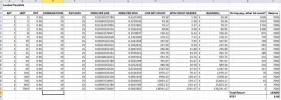
1003334_10151549872951430_489556668_n.webp

You will notice that when the slot completes it's spin cycle, taking the odds of each payline and calculating how many times that pay-line should pay in the selected number of spins - their aggreagte value is 96% of the total amount of money staked.

It's fairly complex without adding volatility into the equation (reducing the odds of lower xbet wins, and increasing the odds of higher xbet wins (and vice versa) while retaining the RTP)

Now, what you are saying is that the engine should calculate 2000 spins and 'count' the number of RANDOM wins that that particular player has achieved, then drastically and rapidly CHANGE the odds for that one player session so the player can experience a losing streak in the next.... how many spins exactly?

Likewise, in your scenario the game engine design is not connected to a single RNG (which it is) and it is not coded to perform at a random outcome at all - the game engine changes probabilities of a win on the fly, per player session, per RTP value while needing to take bet/bankroll ratio into consideration and as it does that, it then changes the payouts of other player sessions in order to reach its now completely imaginary equilibrium.

I'm sorry Jufo, while i am wholeheartedly impressed with your mathematical knowledge, logically and practically above is equal to harnessing the power of lightning or starting cold fusion.

And why??? each spin carries the odds advantage anyway. Given enough players the house ALWAYS wins.

As i said, intangible to me.

 
Sigh,
ok then here are the results for the last time:

Numbers from playing a single $100 bonus through based on 10000 trials:
You do not have permission to view link Log in or register now.


Numbers from playing a single $1000 bonus through based on 10000 trials:
You do not have permission to view link Log in or register now.


Above shows that a single $1000 bonus broken down to ten $100 seprate bonuses both have the same EV, so you are wrong.

If you want to double-verify the numbers here are the exact end results of each run separately in Excel file:
For $200 bankroll:
You do not have permission to view link Log in or register now.

For $2000 bankroll:
You do not have permission to view link Log in or register now.

Double sigh, you cannot be so blinded by mathematics to not see real life effect :what:

PROBABILITY TO MEET PLAYTHROUGH: 26.37%
AVERAGE END BALANCE WHEN MEETING PLAYTHROUGH: 508.25
AVERAGE WAGERED WHEN BUSTING: 1199.72

Out of 100 players getting the bonus of 100 each PLAYING THE SAME GAME AT SAME BET VALUE, 26 players will meet wagering requirement (3,500) and have an average end balance of 508 - meaning they will WALK AWAY with 13,200 in aggregate return, after investing 10,000.

This is YOUR simulation result.

In the case of your single player, he will only have ONE CHANCE to generate the 35,000 required and he can ONLY walk away if he generated 35,000. If at any point he reached a wager of 3,500 while his balance was in profit, it would make no difference as he would not be able to cash our a PART of that bonus, he will have HAD to meet the full 35,000, hence continue playing and also compensate for the other 74% of your statistical segment.

You are running the wrong simulation as i explained a few times, and while your mathematics are infallible, colludes do few REAL LIFE THINGS:

1. Get 10,50,100 times the bonus amount that should be allowed per player and they emulate a single player experience (exact bets, same game engine)
2. Change the nature of the bonus by which 1 player would have to deplete real money first and then play with locked bonus, colludes beat the restrictions of the system by being able to play bonus and real simultaneously.
3. While a single player is forced to see the 35,000 volume through before being able to cash out a cent, 26% of the group can cash out a small portion without arriving at 35,000 aggregate volume.

Yes, your mathematics for your example are 100% correct. and YES it's also true that groups working together influence the conditions the bonus is awarded under.
 
Jufo - I am not looking for 'conspiracies'. This thread is getting out of control how and has been hijacked. All I asked is the kktmd tests for any (yet unproven) effects drastic stake changing could have on the slot games we can test. I am not suggesting they aren't random, or rigged, or anything else. IF any mechanism did exist to put parameters on excessive peaks and troughs on the RTP curves, it wouldn't mean the slot is 'fixed' anyway. Think about it, it could be achieved by nullifying certain values in the pool of results for a series of spins to bring RTP back in - the picks from the pool of values would still be random, and chosen by the RNG anyway. The slot would still pay TRTP over time, all the spins would still be random.

Jufo suggests that there is a prevalence of big wins at the start of a player's account/slot at a casino, over the first 10k spins. This IS a conspiracy theory lol......:)

I have a feeling a couple of people here can't see the wood for the trees........
 
That is pretty interesting and illustrated some naive thinking regarding the sample size on my part. I plucked the 10,000 from nowhere but thinking about things the distribution would skewed over such a small sample size just because there is always the chance that you could win 10,000 x bet plus in a single spin where as the chances of losing 10,000 x bet (ie winning zero on EVERY spin) effectively zero. So the distribution of the RTP is always bounded below by 0% but theoretically unbounded above. I am going to have to think about that a lot more though as it is not immediately obvious to me why the central limit theorem would not hold here (other than the too small sample size).

Could this deviation from normality be down to the feature modes of the games? Considering things like bonus rounds, free spin retriggers etc. I don't suppose that you have a similar analysis of the same data just in the base mode of games?

I suppose perhaps I am making a mistake here of viewing the RTP as a true statistic as it is actually bound intrinsically to the prize payout for each event. Clearly there is some fundamental error in thinking on my part at work here. This is getting a little addictive now and I can see I am not going to be able to let this go....

I appreciate that you are still having the discussion because the reason I first posted here was the opportunity to pick the brain of a PhD in Mathematics ;)

Yes, I think the very reason that on every outcome the maximum you can lose is one unit but can win (almost) unlimited units is what skews the distribution so that even after 10,000 spins it remains skewed. You can see it from the fact that the low RTP end is under tight envelope (tighter than predicted by normal distribution) whereas the winning end of high payouts spreads much further than normal distribution predicts.

If you increase the number of rounds played to 100,000 and to 1,000,000 and so on, it will get closer and closer to normal distribution although quite slowly. There is a rule of thumb which says that the result is not normally distributed until it contains enough rounds to hit the top payout at least a few times. Now on a typical slot the top payout may be a 1 in million event so this rule of thumb says that it would take at least several million rounds until using normal distribution is appropriate.

From casino's point of view they see millions of rounds played across all players so for them the results are (close) to normal distribution. But for an individual player they will never play enough rounds for the result to be normally distributed.
 
Last edited:
Out of 100 players getting the bonus of 100 each PLAYING THE SAME GAME AT SAME BET VALUE, 26 players will meet wagering requirement (3,500) and have an average end balance of 508 - meaning they will WALK AWAY with 13,200 in aggregate return, after investing 10,000.

Yes and...?

10 players play the $1000 bonus and 2.67 of them walks away with an average of 5001 for a total of 13350 after investing 10000 -> same thing.


In the case of your single player, he will only have ONE CHANCE to generate the 35,000 required and he can ONLY walk away if he generated 35,000. If at any point he reached a wager of 3,500 while his balance was in profit, it would make no difference as he would not be able to cash our a PART of that bonus, he will have HAD to meet the full 35,000, hence continue player and also compensate for the other 74% of your statistical segment.

It doesn't matter in terms of EV.

1. Get 10,50,100 times the bonus amount that should be allowed per player and they emulate a single player experience (exact bets, same game engine)
2. Change the nature of the bonus by which 1 player would have to deplete real money first and then play with locked bonus, colludes beat the restrictions of the system by being able to play bonus and real simultaneously.
3. While a single player is forced to see the 35,000 volume through before being able to cash out a cent, 26% of the group can cash out a small portion without arriving at 35,000 aggregate volume.

Yes, your mathematics for your example are 100% correct. and YES it's also true that groups working together influence the conditions the bonus is awarded under.

I guess we have to agree that we are talking about different things and I still don't understand what you are talking about. Anyway I stand by my results, the EV remains unchanged between a single $1000 bonus and ten $100 bonuses.
 
You are running the wrong simulation as i explained a few times, and while your mathematics are infallible, colludes do two REAL LIFE THINGS:

1. Get 10,50,100 times the bonus amount that should be allowed per player and they emulate a single player experience (exact bets, same game engine)
2. Change the nature of the bonus by which 1 player would have to deplete real money first and then play with locked bonus, colludes beat the restrictions of the system by being able to play bonus and real simultaneously.

This has no effect at all if the slot machine is 100% random, you seem to be afraid of collusion in case the machine isn't random. :eek2: A few years ago I Think I read that a manager from the Virtual Group banned a player because he "fed" the machine with bonus money and then "collected" with bonus free money play. :D Your argument seem to be almost the same.
 
This has no effect at all if the slot machine is 100% random, you seem to be afraid of collusion in case the machine isn't random. :eek2: A few years ago I Think I read that a manager from the Virtual Group banned a player because he "fed" the machine with bonus money and then "collected" with bonus free money play. :D Your argument seem to be almost the same.

Actually that's possible on AWP machines.
 
Jufo suggests that there is a prevalence of big wins at the start of a player's account/slot at a casino, over the first 10k spins. This IS a conspiracy theory lol......:)

What, I have never said anything like that :what:

Jufo - I am not looking for 'conspiracies'. This thread is getting out of control how and has been hijacked. All I asked is the kktmd tests for any (yet unproven) effects drastic stake changing could have on the slot games we can test. I am not suggesting they aren't random, or rigged, or anything else. IF any mechanism did exist to put parameters on excessive peaks and troughs on the RTP curves, it wouldn't mean the slot is 'fixed' anyway. Think about it, it could be achieved by nullifying certain values in the pool of results for a series of spins to bring RTP back in - the picks from the pool of values would still be random, and chosen by the RNG anyway. The slot would still pay TRTP over time, all the spins would still be random.

Apologies for the hijack. Of course kktmd is welcome to post any interesting results here.
 
Last edited:
This has no effect at all if the slot machine is 100% random, you seem to be afraid of collusion in case the machine isn't random. :eek2: A few years ago I Think I read that a manager from the Virtual Group banned a player because he "fed" the machine with bonus money and then "collected" with bonus free money play. :D Your argument seem to be almost the same.

Yeah that's what worries me the most. That casino managers apply false mathematics and then make rules that affect players because of that, like accusing a player of "feeding a machine". And yes something like this might be possible on AWPs but not on fair random slots. It almost sounds like Igor is trying to convince us that MG slots are not in fact random and fair :eek:
 
Last edited:
Actually that's possible on AWP machines.

Actually that one of the few 'cheats' that is also possible with certain non-AWP machines. If you play TombRaider II for example, you need to hit a scatter on the center of every wheel to activate the bonus round. You dont have to hit them at the same time, the game remembers which wheels are activated. Your final bonus is a weighted average of the bet you placed when hitting the 5 scatters. So, If you spend all your bonus money betting big and 'loading up' the first 4 wheels, it should be possible to come back later and 'collect'.

I have NOT tried this in real life, so I dont know if the casinos reset these games when the player runs out of bonus money.

Also - obviously its not going to help 'colluders'.
 
Last edited:
Actually that one of the few 'cheats' that is also possible with certain non-AWP machines. If you play TombRaider II for example, you need to hit a scatter on the center of every wheel to activate the bonus round. You dont have to hit them at the same time, the game remembers which wheels are activated. Your final bonus is a weighted average of the bet you placed when hitting the 5 scatters. So, If you spend all your bonus money betting big and 'loading up' the first 4 wheels, it should be possible to come back later and 'collect'.

I have NOT tried this in real life, so I dont know if the casinos reset these games when the player runs out of bonus money.

AFAIK, completing the 5 reels triggers a bonus round where the winnings are BASED on the average bet whilst collecting the other 4 reels.....so you can actually hit almost nothing (have done before) or you can hit really big i.e. it doesn't just give you back an average of your bets.

So, it is not "forceable" per se.
 
AFAIK, completing the 5 reels triggers a bonus round where the winnings are BASED on the average bet whilst collecting the other 4 reels.....so you can actually hit almost nothing (have done before) or you can hit really big i.e. it doesn't just give you back an average of your bets.

So, it is not "forceable" per se.

I have done quite a lot of spins on Tombraider II: The bonus round is a (random number) * (weighted average of the bet you made on the individual spin where you activated the other wheels). So doubling your bet will (on average) double your bonus.

Its the weighted average: the first scatter has much lower weight than the last scatter (since the first scatter is much easier to hit). The weighting is exactly inverse proportional to the probability of hitting the scatter.
 
I have done quite a lot of spins on Tombraider II: The bonus round is a (random number) * (weighted average of the bet you made on the individual spin where you activated the other wheels). So doubling your bet will (on average) double your bonus.

Its the weighted average: the first scatter has much lower weight than the last scatter (since the first scatter is much easier to hit). The weighting is exactly inverse proportional to the probability of hitting the scatter.

Yes, I get that totally.

What I'm saying is that it is no good as a "cheat" using bonus money. You can load it up on big bets until you have 4 using bonus money, and then leave it and come back with real money and try for the 5th. Not only can it take you quite some time to actually get the 5th one, it can, as I say, pay very little. You might not get that much out of it at all...certainly not enough to be throwing away big bets getting the other 4.

It is not a "sure thing" like other "forceable" slots we have seen, as there is no way of telling when the bonus will trigger, unlike Treasure Ireland where reducing the bet will force the machine to pay what is in the pot.

If TRII was "forceable" like this, I'm pretty sure players would be all over it and at least some operators would have excluded it from bonus play, and I haven't seen that anywhere at this stage.
 
Personally, I think each casino should have one slot machine that pays out a flat/guaranteed 95% payback on every spin. Bet a dollar, 'win' .95.... bet another $1 win .95.... bet $2, win $1.90.

;)
 
Personally, I think each casino should have one slot machine that pays out a flat/guaranteed 95% payback on every spin. Bet a dollar, 'win' .95.... bet another $1 win .95.... bet $2, win $1.90.

;)

I am sure that game would be very popular :lolup: But truthfully that's the type of game casino would like to have to have more constant income stream.
 
I have done quite a lot of spins on Tombraider II: The bonus round is a (random number) * (weighted average of the bet you made on the individual spin where you activated the other wheels). So doubling your bet will (on average) double your bonus.

Its the weighted average: the first scatter has much lower weight than the last scatter (since the first scatter is much easier to hit). The weighting is exactly inverse proportional to the probability of hitting the scatter.

Thanks for that insight. I always assumed that the formula to calculate the payout for the bonus round was simply the average of bets when triggering the five passports. This means that you should actually bet big on the first passports (as they are easier to collect) and reduce your stake towards the end and still get a decent bonus round award because of those big bets on the "easier" passports.

So have you confirmed that the weights calculated for the bonus award are directly proportional to the difficulty of getting a passport? This makes sense as it would protect the game from being beatable by the strategy outlined above. However, it also makes the use of bonus funds to collect passports not too practical because the last, fifth passport that you collect with your own cash will have the largest weighting, meaning that large portion of the feature payout is not derived from bonus funds at all, just like Nifty said.
 
Yes, I have confirmed that the weighting is exactly inverse proportional with the probability of hitting the scatter (so the last scatter is weighted much higher than the first).

If they were equally weighted, you could raise RTP significantly (well over 100%) by betting big in the very beginning. I don't remember the wheel length or the bonus round contribution to RTP, but I seem to remember that you will typically hit the first scatter within 20-30 spins.

One important aspect: You can choose to play one line, so the minimum bet is only 1¢. If you "load up" the first 4 wheels, and play 1¢ spins while waiting for the 5. th wheel, it will only cost a few $ (at most) to get the final scatter and get the bonus round. The last scatter wound not contribute to the bonus payout, but the first 4 scatters still make up 2/3 of the weighting.

If I remember the weighting correctly:

1: 1/15
2: 2/15
3: 3/15
4: 4/15
5: 5/15

So by starting your bonus play by "loading up" the first 4 reels before moving on to other games, a player could change bonus EV substantially.
 
Jufo - I am not looking for 'conspiracies'. This thread is getting out of control how and has been hijacked. All I asked is the kktmd tests for any (yet unproven) effects drastic stake changing could have on the slot games we can test. I am not suggesting they aren't random, or rigged, or anything else. IF any mechanism did exist to put parameters on excessive peaks and troughs on the RTP curves, it wouldn't mean the slot is 'fixed' anyway. Think about it, it could be achieved by nullifying certain values in the pool of results for a series of spins to bring RTP back in - the picks from the pool of values would still be random, and chosen by the RNG anyway. The slot would still pay TRTP over time, all the spins would still be random.

Jufo suggests that there is a prevalence of big wins at the start of a player's account/slot at a casino, over the first 10k spins. This IS a conspiracy theory lol......:)

I have a feeling a couple of people here can't see the wood for the trees........

But nobody is saying that the games are rigged though are they? I thought that was pretty much established based on Jufos initial analysis of that poor guys data (the one who lost 85K). I thought we were only theorizing about the internal mechanics in the game engines. I have not once inferred that I think slots are in any way rigged or that there are conspiracies. The thing that grabbed my initial interest was the notion of having non-constant probabilities for each payout amount but that fluctuated in a manner that still resulted in a fair game. That was disproved through the gaming license requirements - but I never suggested the games were rigged at all. If I did I would not spend (lose) the amount per month on slots that I currently do....
 
But nobody is saying that the games are rigged though are they? I thought that was pretty much established based on Jufos initial analysis of that poor guys data (the one who lost 85K). I thought we were only theorizing about the internal mechanics in the game engines. I have not once inferred that I think slots are in any way rigged or that there are conspiracies. The thing that grabbed my initial interest was the notion of having non-constant probabilities for each payout amount but that fluctuated in a manner that still resulted in a fair game. That was disproved through the gaming license requirements - but I never suggested the games were rigged at all. If I did I would not spend (lose) the amount per month on slots that I currently do....

I am surprised you type that when I was replying to Jufo's comments, not yours.
 
I appreciate that you are still having the discussion because the reason I first posted here was the opportunity to pick the brain of a PhD in Mathematics ;)

Yes, I think the very reason that on every outcome the maximum you can lose is one unit but can win (almost) unlimited units is what skews the distribution so that even after 10,000 spins it remains skewed. You can see it from the fact that the low RTP end is under tight envelope (tighter than predicted by normal distribution) whereas the winning end of high payouts spreads much further than normal distribution predicts.

If you increase the number of rounds played to 100,000 and to 1,000,000 and so on, it will get closer and closer to normal distribution although quite slowly. There is a rule of thumb which says that the result is not normally distributed until it contains enough rounds to hit the top payout at least a few times. Now on a typical slot the top payout may be a 1 in million event so this rule of thumb says that it would take at least several million rounds until using normal distribution is appropriate.

From casino's point of view they see millions of rounds played across all players so for them the results are (close) to normal distribution. But for an individual player they will never play enough rounds for the result to be normally distributed.


I think then that the best way to look at it is completely separate from RTP. Based on reel layouts, IF the RNG is generating a number randomly to specify the reel position, then assuming non-weighted reels and known reel layout, we can perform the same chi-square test around an assumption of a uniform distribution over every possible reel position. This would be a more comprehensive test - if each reel combo can be shown to have the same probability of coming in, then that is all there is to show. The game TRTP and slot variance is totally set by the value associated with each symbol win. Excluding stuff like "Wild Desire" and "Ion Storm" and that kind of outcome. It would show without doubt the fairness of the RNG behind it all (which I am not disputing just to labour the point).

Problem is that this would likely require a truly massive sample size to operate on as even with only 20 symbols per reel on a 5 reel slot would result in 3.2 million distinct reel positions (and we know most games are not limited to only 20 symbols per reel).

This probably illustrates just how small that 10,000 sample size is in your analysis (even though that is a totally different type of analysis).

Maybe that doesn't make sense but it clears it up in my mind, as the RTP aspect (which confuses the issue for me) allows heavily tailed sampling distributions.
 
I agree that this thread got very confusing because of many simultaneous different things discussed and some unnecessary stuff that was brought over from other threads. But this is what happens when too many different "cooks" turn up with their own ideas. Anyway back to the original discussion:

I think then that the best way to look at it is completely separate from RTP. Based on reel layouts, IF the RNG is generating a number randomly to specify the reel position, then assuming non-weighted reels and known reel layout, we can perform the same chi-square test around an assumption of a uniform distribution over every possible reel position. This would be a more comprehensive test - if each reel combo can be shown to have the same probability of coming in, then that is all there is to show. The game TRTP and slot variance is totally set by the value associated with each symbol win. Excluding stuff like "Wild Desire" and "Ion Storm" and that kind of outcome. It would show without doubt the fairness of the RNG behind it all (which I am not disputing just to labour the point).

Problem is that this would likely require a truly massive sample size to operate on as even with only 20 symbols per reel on a 5 reel slot would result in 3.2 million distinct reel positions (and we know most games are not limited to only 20 symbols per reel).

This probably illustrates just how small that 10,000 sample size is in your analysis (even though that is a totally different type of analysis).

Maybe that doesn't make sense but it clears it up in my mind, as the RTP aspect (which confuses the issue for me) allows heavily tailed sampling distributions.

Yes that would be comprehensive analysis but I am not sure if it is necessary. For example there are many different possible reel configurations that yield a payout of, say, 3.5x bet. It's already possible to calculate the overall probability for that payout so I don't think it gives any extra insight to see all the possible reel orientations that yield that particular payout. Therefore wouldn't you say that simply knowing the entire payout structure (ie. the probability for each payout) would be sufficient? The paytable (list of each possible payout and it's probability) captures the mathematics of the slot entirely and it's not that interesting to know all the different possible ways to arrive at each of these probabilities.

I already had the full slot paytable available when I analysed that person's BDBA results. In the report I only posted ranges like 50-100x bet but these were derived from the exact paytable. The paytable was generated from a simulation of 100 million spins rather than exact combinatory analysis but IMO it is accurate enough.

I still think that in addition to verifying A) TRTP B) The frequencies of each payout, a third statistical test should be made to verify that the payouts occur at randomly distributed intervals. While you might feel that this last step is unnecessary, it's the one that distinguishes a truly random slot from an AWP machine. AWP machine "eats" player's money and only gives a payout after enough money has been "eaten". So we still need some statistical test to eliminate the possibility that there are some AWP-like behaviours incorporated within these slots so that they are truly random.
 
Last edited:
I agree that this thread got very confusing because of many simultaneous different things discussed and some unnecessary stuff that was brought over from other threads. But this is what happens when too many different "cooks" turn up with their own ideas. Anyway back to the original discussion:


Yes that would be comprehensive analysis but I am not sure if it is necessary. For example there are many different possible reel configurations that yield a payout of, say, 3.5x bet. It's already possible to calculate the overall probability for that payout so I don't think it gives any extra insight to see all the possible reel orientations that yield that particular payout. Therefore wouldn't you say that simply knowing the entire payout structure (ie. the probability for each payout) would be sufficient? The paytable (list of each possible payout and it's probability) captures the mathematics of the slot entirely and it's not that interesting to know all the different possible ways to arrive at each of these probabilities.

I already had the full slot paytable available when I analysed that person's BDBA results. In the report I only posted ranges like 50-100x bet but these were derived from the exact paytable. The paytable was generated from a simulation of 100 million spins rather than exact combinatory analysis but IMO that is accurate enough.

I still think that in addition to verifying A) TRTP B) The frequencies of each payout, a third statistical test should be made to verify that the payouts occur at randomly distributed intervals. While you might feel that this last step is unnecessary, it's the one that distinguishes a truly random slot from an AWP machine. AWP machine "eats" player's money and only gives a payout after enough money has been "eaten". So we still need some statistical test to eliminate the possibility that there are some AWP-like behaviours incorporated within these slots, and that they are truly random.

So, after all the over-complication and over-analysis, we are back to square one - the question I asked kktmd - to perform tests - running stake changes in order to demonstrate if or not the slot can be shown to exhibit some AWP tendencies.

I am honest enough here to declare a foil-hat statement I made in the past. When I saw these multi-thousand WD screenies on IR, I accused the players of 'buying' the wins, i.e. having already lost enough overall to pay for them. Only one person claimed to have had their massive hit just after starting out on the slot before they had played it a lot.
 
So, after all the over-complication and over-analysis, we are back to square one - the question I asked kktmd - to perform tests - running stake changes in order to demonstrate if or not the slot can be shown to exhibit some AWP tendencies.

I am honest enough here to declare a foil-hat statement I made in the past. When I saw these multi-thousand WD screenies on IR, I accused the players of 'buying' the wins, i.e. having already lost enough overall to pay for them. Only one person claimed to have had their massive hit just after starting out on the slot before they had played it a lot.

Well that could still be looked at, but I think it would need to be run on free play but changing stake in a controlled manner. Something like blocks of 10 bets stake 0.30c say then 10 bets at $1.50 (or something similar) so that there was a structured betting pattern but not too spread apart. That way you would end up with 2 distinct groups of results. Testing for significant differences between 2 groups that are supposed to be the same is more easy to analyse. I think it would be a good idea to keep it to just 2 distinct stakes though and to keep the intervals between the stake changes equal though.
 
So, after all the over-complication and over-analysis, we are back to square one - the question I asked kktmd - to perform tests - running stake changes in order to demonstrate if or not the slot can be shown to exhibit some AWP tendencies.

Well yes, the thread was sidetracked but it was not only because of me.

Kktmd's approach has a few problems and weaknesses. I understand that he already has all the data from the spins and he changes the bet sizes post-playing by just changing them in his records. Therefore his trials don't reveal whether a bet change during actual play (and not only post-play) would have made a difference.

The other problem is that this is fun-mode data collection and there is no quarantee that real-money mode is exactly the same. You can be convinced that it is the same but there is still uncertainty. If I ran compromised games I would make sure they are compromised only in real play.

The last problem is that there should be some way to quantify kktmd's findings. If he discovers that changing bet size at certain point makes the slot deliver 98% return rather than 95% we need to establish how likely this is to happen by random chance to rule it out.

Therefore I hope that you agree that it is a good thing (and not a bad thing) that other related ideas are proposed in this thread as well.
 
Well yes, the thread was sidetracked but it was not only because of me.

Kktmd's approach has a few problems and weaknesses. I understand that he already has all the data from the spins and he changes the bet sizes post-playing by just changing them in his records. Therefore his trials don't reveal whether a bet change during actual play (and not only post-play) would have made a difference.

The other problem is that this is fun-mode data collection and there is no quarantee that real-money mode is exactly the same. You can be convinced that it is the same but there is still uncertainty. If I ran compromised games I would make sure they are compromised only in real play.

The last problem is that there should be some way to quantify kktmd's findings. If he discovers that changing bet size at certain point makes the slot deliver 98% return rather than 95% we need to establish how likely this is to happen by random chance to rule it out.

Therefore I hope that you agree that it is a good thing (and not a bad thing) that other related ideas are proposed in this thread as well.

These are excellent points.

1. I'm not 100% convinced that real-mode=fun-mode

My theory is this:
2. If we had enough spins, it should not be possible increase RTP by "post-playin" the series using any system (without using information about future spins, of course). If we can find a system that consistently increases RTP, this is could indicate non-random behaviour.
3. IF we find a system and IF we play this system in fun-mode and our RTP does NOT increase, this could indicate that the game engine adjusts RTP to meet a certain target.

I've put about 260k spins on Playboy (fun-mode) since yesterday, using this system:
60 spins betting 30, followed by 10 spins betting 1500. Repeat.
 
Well yes, the thread was sidetracked but it was not only because of me.

Kktmd's approach has a few problems and weaknesses. I understand that he already has all the data from the spins and he changes the bet sizes post-playing by just changing them in his records. Therefore his trials don't reveal whether a bet change during actual play (and not only post-play) would have made a difference.

Yes, I didn't realize he'd done it ex-post-facto. Thanks.

The other problem is that this is fun-mode data collection and there is no quarantee that real-money mode is exactly the same. You can be convinced that it is the same but there is still uncertainty. If I ran compromised games I would make sure they are compromised only in real play.#

That's not true though - we are told they use the same server/game and this is in keeping with the GA rules. It would be a serious matter if this were the case and I don't believe it is.

The last problem is that there should be some way to quantify kktmd's findings. If he discovers that changing bet size at certain point makes the slot deliver 98% return rather than 95% we need to establish how likely this is to happen by random chance to rule it out.

Very true but we won't do it with ten spins at one stake then ten at another and so-on. It's too insignificant to separate any potential peak from a random one.

Therefore I hope that you agree that it is a good thing (and not a bad thing) that other related ideas are proposed in this thread as well.

It is good, but we seem to be beating around the bush. We need to agree a way to test we are all happy with.
 
These are excellent points.

1. I'm not 100% convinced that real-mode=fun-mode

My theory is this:
2. If we had enough spins, it should not be possible increase RTP by "post-playin" the series using any system (without using information about future spins, of course). If we can find a system that consistently increases RTP, this is could indicate non-random behaviour.
Yes.
3. IF we find a system and IF we play this system in fun-mode and our RTP does NOT increase, this could indicate that the game engine adjusts RTP to meet a certain target.
I think this is the most likely and would reflect a true random slot - having dynamic parameters doesn't necessarily make it 'rigged' i.e. non-random.

I've put about 260k spins on Playboy (fun-mode) since yesterday, using this system:
60 spins betting 30, followed by 10 spins betting 1500. Repeat.

Not dramatic enough. In such a few spins 60/10 60/10 etc. it simply is a short-term bet of 11.2 1500 spins. Pointless I maintain.

kktmd I repeat do at least 2000 spins at 30p followed by a big raise to at least £10 a spin for 20 spins. This equates to 600 pounds spent at 30p then 200 pounds spent at £10. One total is significantly less than the other so a contrast/effect would be more clearly demonstrated and less refutable. This also better echoes the real player, who bangs out 2000 spins in 2 hours, gets fed up and bumps his stake up to either bust out or get his money back. As we've seen many a time.

1 of 3 things will happen:

1. Nothing.
2. A temporary spike in RTP that levels out as the pattern of spins continues. Likely.
3. (unlikely but possible) You get a permanent increase in RTP which would mean the slot is skewed.
 

Users who are viewing this thread

Accredited Casinos

Read about our rating system and how it's done.
Back
Top