Ok, so let's theorise that MGS has casino benefits at heart and 5% flat commissions across billions in volume isn't enough. Let's theorise that they would risk the overwhelming repercussions that game rigging would have, in order to benefit the casinos on the 2000 spins per player statistical analisys.
By the way, 2000 * 10,000 is a mere 20 million spins. It's laughable in terms of amount of transactions a single large operator goes through, but i understand we need a a sample to go by.
Can I ask what is your margin for error? The 36% you returned; in how may groups of 10,000*2000 spins did the 36% of 2000 yielded a profit?
What i mean is, for the 3,600 profiting players in the 10,000: did you also arrive at
EXACTLY 36 profiting players for each segment of 100 players, because
that would be worrying. If you on the other hand arrived at 60 in the first 100, 5 in the second, 36 in the third, 80 in the fourth, etc...
Is it always 36% or does that number vary? If you did 10,000 simulations, on 10,000 players player 2,000 spins each - what do you think would be your lowest point of profitable players and what would be your highest? Do you think each simulation of 10,000 players would yield exactly 36%?
This is the second time I saw you take averages to deduce outcome, while speaking about a RANDOM series of outcomes. Averages play no role here -
the only way to deduce anything worth considering is if you found a cycle, a repetition, a number that systematically comes out after series and series of spins.
Just saying that 36% of players in 10,000 players yielded profit means so little. Now, saying that in 10,000 simulations of 10,000 players, each playing 2,000 spins - the number of profiting players per 10k ranges between 35.9% and 36.1% is really saying something. You have my eyes, ears, arms and legs to see this through in that case.
So back to topic, MGS tweaking games for the benefit of a single casino:
What would the the aim here? Reduce he 36% to 20%, right? While keeping RTP at 96% of course..
Ok, i agree. How do we do that? First we need to understnad how the machine works:
1.Machine has to recognise the player. Since machine is an MGS machine hooked up to an RNG, that's given to multitude of operators, how do we recognise you playing on Ladbrokes, vs you playing on 32 red? We dont, so let's say it's YOUR rtp, per operator id.
So now you have a machine that opens your "session" for your account under that casino ID; and now it's 'looking' at you.

just makes me giggle so much.
How does a non-aware machine work though?
A machine can have anywhere form 20 to 50 different pay-line wins. I mean here different xbet win amounts. Each one of those xbet winning combinations will ensure - that over 100,000,000 (100 million, read: infinite) spins when that pay-line hits with a combination of every other pay-line the machine RTP will be infallible.
So now we have a constant: Machine TRTP = 0.96 and we know that the odds of each payline i within the machine absolutely must balance each other out to ensure TRTP is not influenced (before even taking player rounds into consideration)
So say for a machine that has lets say 25 different xbet winning combinations, probability of each of those combinations needs to look like this:
ODDS=(TRTP*(1/XBET))/COMBINATIONS, where
ODDS= probability of win
TRTP= overall machine RTP
XBET= winning pay-line (1x,2x,5x,10x,etc.)
COMBINATIONS= number of different winning pay-lines
So for example, to calculate how often x10 bet happens on a slot that has 25 different winning values and RTP of 96%:
ODDS=(0.96*(1/10))/25=0.00384 or 1 in 260 spins. Do this formula for any XBET (x1000 bet, x500 bet) and as long as you know the variables above it will be mathematically infallible.
Here is a sample for a slot that has 19 different winning combinations in its most basic (non-varibale) format:
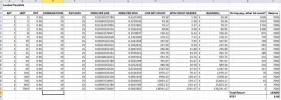
You will notice that when the slot completes it's spin cycle, taking the odds of each payline and calculating how many times that pay-line should pay in the selected number of spins - their aggreagte value is 96% of the total amount of money staked.
It's fairly complex without adding volatility into the equation (reducing the odds of lower xbet wins, and increasing the odds of higher xbet wins (and vice versa) while retaining the RTP)
Now, what you are saying is that the engine should calculate 2000 spins and 'count' the number of RANDOM wins that that particular player has achieved, then drastically and rapidly CHANGE the odds for that one player session so the player can experience a losing streak in the next.... how many spins exactly?
Likewise, in your scenario the game engine design is not connected to a single RNG (which it is) and it is not coded to perform at a random outcome at all - the game engine changes probabilities of a win on the fly, per player session, per RTP value while needing to take bet/bankroll ratio into consideration and as it does that, it then changes the payouts of other player sessions in order to reach its now completely imaginary equilibrium.
I'm sorry Jufo, while i am wholeheartedly impressed with your mathematical knowledge,
logically and practically above is equal to harnessing the power of lightning or starting cold fusion.
And why??? each spin carries the odds advantage anyway. Given enough players the house ALWAYS wins.
As i said, intangible to me.






 AP's contacted you, telling you stop proving their "lack" of ability to beat the casino? Ok, that makes sense.


 A few years ago I Think I read that a manager from the Virtual Group banned a player because he "fed" the machine with bonus money and then "collected" with bonus free money play.
  Your argument seem to be almost the same.