Before Man.
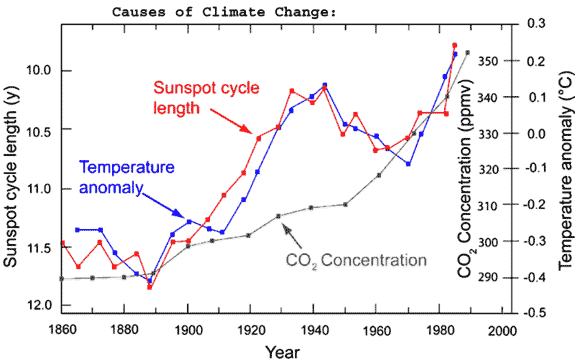
Changes in energy input (sun's output, Earth's orbit, etc) was the main driving force behind changes in climate. An increase in energy input will occur if the sun's output increases, and/or the Earth's orbit takes it closer to the Sun.
The increase in energy input increased the temperature, this in turn warmed the oceans, which released their CO2.
In this case, temperature rise will precede the rise in CO2, evidence the detractors to the theory that CO2 increase is what causes temperature rise use to discredit "Climate Change through man's emission of greenhouse gasses"
In the above case, the increase in CO2 acts as positive feedback, enhancing the increase in temperature, even though graphs may still show temperature rise before CO2 rise, masking the effects of this feedback mechanism.
Eventually, the amount of energy input starts to reduce, the Earth's orbit returns to a "Glacial" position, and/or the sun's output decreases. A point is reached where, despite the CO2 concentration, the Earth does not receive enough energy to continue heating up. Temperatures fall, and this is followed by a fall in CO2 as it is more efficiently absorbed into cooler oceans. Again, this looks "back to front" from what we might expect under the "Global Warming" theory.
Man gets involved:-
It is not so much that man made CO2 DIRECTLY creates "Global Warming", it interferes with the feedback mechanism. Increased CO2 is supposed to FOLLOW an increase in temperature, but by burning fossil fuels, man is enhancing this feedback mechanism, and so NOW we have CO2 rising BEFORE the temperature rises. Now, the orbit and sun's output are NOT driving the changes, it is the CO2 increase that is no longer a feedback response to rising energy input, but an acting force in it's own right.
If we ARE entering a period where the energy input increases due to changes in the orbit or the sun's output - oh Crap! This is what we have to fear, because the warming will be very much ENHANCED by the human intervention, even if not CAUSED by it. The eventual upward swing could easily surpass anything that would have occurred naturally.
We could get lucky though, maybe other factors are pushing the Earth into a cooling phase, and the 1970's doom-mongers were correct. Our production of CO2 has held off the cooling effect somewhat, and we have ended up with a net warming, which many scientists have thought to be too LITTLE given what they had expected from their calculations.
An effect revealed fairly recently was that our burning of fossil fuels created lots of POLLUTION, which acted as a "solar filter", negating some of the effects of increasing CO2. The various "clean air" initiatives removed much of this filtering effect, but none of the CO2 production. This could have confused scientists who were expecting a steady warming since we started pumping out CO2.
Apart from CO2, we have the worry of "tipping points" being reached, where the system varies so far from it's natural range that recovery becomes almost impossible.
One such event in the past was known as "Snowball Earth", an extreme glacial period that could not be ended by the Earth moving into it's interglacial orbit. The ending was believed to have come from very enhanced volcanism, melting some of the ice, depositing dark material on the rest (making it easier to melt), and pumping CO2 into the atmosphere, which lasted longer than the cooling pollutants.
These extremes in the past are also thought to result from changes in the position of the land masses.
The current worry is that the oceans can get so warm that Methane, trapped as solid at high pressure and near zero Celsius at the ocean floor, could be released, and become a greenhouse gas, causing a far greater runaway effect than could be achieved by CO2 alone. Melting permafrost is a worry, since it would enable this "tipping point" to be reached.
"Global Warming" however, is still THEORY, in that we will suffer a steady long term warming and "disaster" by 2100 if we do nothing. Other unforeseen events may eliminate the warming, and may even be extreme enough to reverse the trend. This might occur BECAUSE the system has been "forced" so violently, it will oscillate wildly, and one of these oscillations could be what triggers the dramatic reversal.
Recent winters in the Northern hemisphere are said to have INCREASED the size of some glaciers, due to large amounts of snowfall. This could be because much of the Earth has warmed in the past, and more moisture can be carried and deposited as snow. If there is a widespread and large enhancement of snowfall over a number of winters (doesn't have to be that many), it could tip the balance, creating more surface ice, more reflection of incoming solar energy, enough perhaps to overcome the effects of the levels of greenhouse gasses.
Politicians have muddied the waters somewhat. They need something to tax, and to make the population accepting of a new tax, it needs to be on something "bad for you". Hence, we have high taxes on Tobacco, Alcohol, and in some cases, fuel for cars. "Global Warming" is an excuse to tax something ELSE that is "bad for us", so their motives are questioned. Is it REALLY that bad, or are they just looking for something to tax.
There are some SERIOUS cases of "double standards" too, on the one hand we are told CO2 emissions will have to decrease by "impossible" levels if we are to survive, yet the same government is prepared to bulldoze a village and a few grade 1 listed buildings to INCREASE capacity at Heathrow airport, which will only encourage more of us to fly. Oddly enough, when MOTORISTS ask about road schemes, they are told "won't work, as soon as we widen the road, it will encourage more cars onto it, and we will be back where we started". Surely the same will happen at Heathrow, MORE people will fly, filling up the capacity, and Heathrow will be overcrowded yet again. Well, it has happened before at Heathrow, increased capacity is followed by more people flying, and capacity has to be increased again and again.
In terms of CO2 emissions, flying is the WORST possible choice, even though it takes the least time, and is therefore the most convenient option for the economy.






 If I were to wager in a pool, I'd bet April Fools Day! You ?


 Hopefully though, you guys will actually start to get this bigger picture here about how all of this Climate talk is just simply a means of getting to the real crux of what their global agenda plans really are and is simply a way and means approach of implementing it. I sincerely do wish that you guys would delve deeper into all of this....